Read full review of Nocturnal Submissions - ZEIGENBOCK KOPF on Boomkat.com ©


2010/04/10
2010/03/18
TEXAS #4
Sorry I didn't post this yesterday as I it was my first night at SxSW and we got back at around 330 after a night of catching Duchess Says [http://www.myspace.com/duchesssays] and Acid Mothers Temple [http://www.myspace.com/acidmotherstemple]. For free no less.
We left Houston yesterday at around 3 or so and after a quick and gluttonous brunch at Jack in the Box (known locally as Crack in the Box and Jack in the Crack) we set out through shitty backwoods highways until we reached our destination.
When we arrived in Austin, we found the address of the house we're staying at, which is where like 30 bands will be playing over the next few nights, was not exactly located on Austin's equivalent of St-Laurent and Prince-Arthur. Instead, the hood reminded us of something out of South Central L.A./Compton, with a dash of Mexican thrown in. But skeazy neighbourhood or not, we were in good spirits and even way out of the downtown core, we could feel the nervous agitation in the air. There were hundreds of shows going on around town at that instant and most if not all the American and European independent music scene had their eyes set on little old Austin, population 700,000.
When we arrived in Austin, we found the address of the house we're staying at, which is where like 30 bands will be playing over the next few nights, was not exactly located on Austin's equivalent of St-Laurent and Prince-Arthur. Instead, the hood reminded us of something out of South Central L.A./Compton, with a dash of Mexican thrown in. But skeazy neighbourhood or not, we were in good spirits and even way out of the downtown core, we could feel the nervous agitation in the air. There were hundreds of shows going on around town at that instant and most if not all the American and European independent music scene had their eyes set on little old Austin, population 700,000.
We met nice people like Nick from Philadelphia who's in this band Procedure Club [http://www.myspace.com/procedureclub] and Chris from Gape Attack! [http://www.myspace.com/gapeattack], as well as others. The house is really not very big and the room we're playing with is only marginally larger than my bachelor apartment.
At around 1030 we set out for the city. I tried calling every cab company in town but of course, all their lines were jammed. This is the first night of SxSW Music.
So after discussing between the Alien8 Showcase andhipster woodstock, which was where of our housemates were going, we ended up catching the bus of all things 15 minutes to downtown Austin. I'll talk about the buses here tomorrow, because we[rape faction]'re going on in an hour or so.
Duchess Says was pretty awesome. We semi snuck our way into the venue (door was 5 bucks *if* you weren't one sly fox) and ended up in the front row of a show that had maybe 80 to 90 people. They sounded in top-form and the band are robotically tight now after all their touring. After the song they were playing ended, we rose up in separatist chants and slogans (Vive le Quebec libre! Vive le Montreal! Cinq-un-quatre!) which seemed to amuse their singer Annie-Claude.
The concert just got wilder and dirtier from there as Annie-Claude stepped into the audience and proceeded to start moshing with Mike and Michaela. For their last song she lead the entire audience out towards the entrance and proceeded to fall on the sidewalk, dancing and writhing like a , uh, like a wraith.
So good show. After them, there was this three piece of local Austin hippies called Ya Ho Wa 13 [http://en.wikipedia.org/wiki/Ya_Ho_Wha_13] who jammed for their entire set.
But for however good Duchess Says, Acid Mothers Temple fucking blasted the whole room. Was one of the best sets I've ever seen and already made this whole crazy trip worthwhile. Words I could use but then I'd sound like a music critic. I'll put this laconically - if they're in town, go see them. Trust me.
But for however good Duchess Says, Acid Mothers Temple fucking blasted the whole room. Was one of the best sets I've ever seen and already made this whole crazy trip worthwhile. Words I could use but then I'd sound like a music critic. I'll put this laconically - if they're in town, go see them. Trust me.
Ok, I gotta run and tune guitars and get set up. Catch y'all niggaz later.
2010/03/17
TEXAS #3
So we saw a dead possum today. But that's for after.
The day began late as usual but an hour earlier than planned (Mike hasn't updated his phone to central time yet). After indulging in Cap'n Crunch With Crunchberries (a delicacy foreign to Canada) we retired to our little bedroom studio. It rained today for the first time since we arrived, but it was a drizzly, half-hearted kind of rain.
Let me take a moment to describe some of the lovely people we're staying with in this lovely old-fashioned home north of Houston. The mistress of the house is Nana, a kindly genteel Southern woman who is Tara's grandmother (Tara being James's wife). She has cancer and spends most of the day in her room watching crime shows. Oh, she also owns a large pump-action shotgun which she keeps bedside in case 'anybody tries to break in and rape and kill her.' James warned us that she's hyper-conservative but honestly, she's been nothing but kind to me. Though we're all kind of constantly aware that our brand of noize-rock and liberal Canadian values could easily result in our sudden and bloody deaths at any moment. As I type this, this woman sleeps a few feet down the hallway. Or maybe she's awake, waiting to spring her deadly trap.
The other two guests staying at the house are Morton and Tomas. They are from Copenhagen, Denmark and they are two of the coolest Danes you will ever meet, believe you me. They don't drink or smoke or take drugs because as Tomas says 'I spend all my money on music.' They arrived here a couple days before us and they spend a lot of time on their laptops designing flyers for our upcoming shows in Austin and doing record label business. After all, from what I understand, they are some of the main players in Skrot Up (http://www.myspace.com/skrotup).
Then there's James, who's as close to my mind's idea of what Kevin Shields (of My Bloody Valentine you philistine) as anybody I've ever met. Quiet, soft-spoken but wise and generous. His wife Tara plays in Lashes (http://www.myspace.com/lashesnoise) and together they form Pink Playground (http://www.myspace.com/pinkplayground3). Tara is similar to James in personality and they are both super-awesome cool people who are kinda stuck in middle America. But they've accepted that fact and are almost proud to be labeled 'freaks' by the Republic-Biblethumping-rednecks they are forced to share a state with. They also make pretty fantastic music. They met in middle school around the time Tara was 14 and now they have a sweet daughter who's 7 and likes playing videogames with fairies.
So that's our cast of characters. After dickin' around for a lil' bit, we finally decided to actually practise for the first time since arriving on Sunday. To jam, we're using our own pedals and James and Tara's two Marshall MG100DFX amps for the guitars and a decent sized Samick bass amp. We managed to get through two sets of music before hunger struck. Since we had tried out Tex-Mex the day before, we decided to go for the 'authentic American breakfast' experience, which could only mean one thing : Denny's (www.dennys.com).
The Denny's that Tara took us to provided a fantastic breakfast. I got the "choose your own Grand Slam" for $5.99 (taxes in Texas are about 8%). We also got to sit in the smoking section, a novelty for Quebecers used to being scorned and demonized for smokin' a fag now and then. The patrons were as authentically Texas as could be (think Billy Bob Thornton from Sling Blade) but the waiter was a dear who admitted he thought we were 'great.'
After that, we got to explore the consumerist side of average American life by visiting a Target department store. Just to give you an idea of how fucking massive this store was, there were 24 checkout aisles, an entire Wal-Mart sized department store, a whole supermarket, and a bevy of little side boutiques like the Photo Studio and the pharmacy and such. It was a little overwhelming and that old Clash tune about the supermarket began ringing in my ears.
Then we went to a native smoke shop where taxes don't exist to pick up a carton of Marlboro mediums. I wanted the Reds but the others didn't think they could handle such extreme American tobacco flavour. We also went to a cool record store where I found a copy of Section 25's Looking From a Hilltop single but it was $30 and out of my budget. Big ups to Tara for taking us to these cool places and tolerating all our obnoxious pointing at things and commenting.
When we got back, we recorded a new-ish song called "Super Free," which is still in rough form but may go up on the MySpace in the next couple of days if we finish mixing it.
To cap off the evening, myself Michaela and Mike decided to make an ill-advised attempt to purchase alcohol, which involved walking like 20 minutes down the side of the road (the same one we went along yesterday). Instead of getting honked at, we saw a dead possum , which was interesting I suppose because I had never seen one before. In the end though, I forgot my I.D. and all the alcohol-selling establishments closed up shop by midnight.
That's day three. I promise the next few days will be more exciting because we're going to Austin and tomorrow's when SxSW starts for real.
Ta MTLers.
=//Turnquest
The day began late as usual but an hour earlier than planned (Mike hasn't updated his phone to central time yet). After indulging in Cap'n Crunch With Crunchberries (a delicacy foreign to Canada) we retired to our little bedroom studio. It rained today for the first time since we arrived, but it was a drizzly, half-hearted kind of rain.
Let me take a moment to describe some of the lovely people we're staying with in this lovely old-fashioned home north of Houston. The mistress of the house is Nana, a kindly genteel Southern woman who is Tara's grandmother (Tara being James's wife). She has cancer and spends most of the day in her room watching crime shows. Oh, she also owns a large pump-action shotgun which she keeps bedside in case 'anybody tries to break in and rape and kill her.' James warned us that she's hyper-conservative but honestly, she's been nothing but kind to me. Though we're all kind of constantly aware that our brand of noize-rock and liberal Canadian values could easily result in our sudden and bloody deaths at any moment. As I type this, this woman sleeps a few feet down the hallway. Or maybe she's awake, waiting to spring her deadly trap.
The other two guests staying at the house are Morton and Tomas. They are from Copenhagen, Denmark and they are two of the coolest Danes you will ever meet, believe you me. They don't drink or smoke or take drugs because as Tomas says 'I spend all my money on music.' They arrived here a couple days before us and they spend a lot of time on their laptops designing flyers for our upcoming shows in Austin and doing record label business. After all, from what I understand, they are some of the main players in Skrot Up (http://www.myspace.com/skrotup).
Then there's James, who's as close to my mind's idea of what Kevin Shields (of My Bloody Valentine you philistine) as anybody I've ever met. Quiet, soft-spoken but wise and generous. His wife Tara plays in Lashes (http://www.myspace.com/lashesnoise) and together they form Pink Playground (http://www.myspace.com/pinkplayground3). Tara is similar to James in personality and they are both super-awesome cool people who are kinda stuck in middle America. But they've accepted that fact and are almost proud to be labeled 'freaks' by the Republic-Biblethumping-rednecks they are forced to share a state with. They also make pretty fantastic music. They met in middle school around the time Tara was 14 and now they have a sweet daughter who's 7 and likes playing videogames with fairies.
So that's our cast of characters. After dickin' around for a lil' bit, we finally decided to actually practise for the first time since arriving on Sunday. To jam, we're using our own pedals and James and Tara's two Marshall MG100DFX amps for the guitars and a decent sized Samick bass amp. We managed to get through two sets of music before hunger struck. Since we had tried out Tex-Mex the day before, we decided to go for the 'authentic American breakfast' experience, which could only mean one thing : Denny's (www.dennys.com).
The Denny's that Tara took us to provided a fantastic breakfast. I got the "choose your own Grand Slam" for $5.99 (taxes in Texas are about 8%). We also got to sit in the smoking section, a novelty for Quebecers used to being scorned and demonized for smokin' a fag now and then. The patrons were as authentically Texas as could be (think Billy Bob Thornton from Sling Blade) but the waiter was a dear who admitted he thought we were 'great.'
After that, we got to explore the consumerist side of average American life by visiting a Target department store. Just to give you an idea of how fucking massive this store was, there were 24 checkout aisles, an entire Wal-Mart sized department store, a whole supermarket, and a bevy of little side boutiques like the Photo Studio and the pharmacy and such. It was a little overwhelming and that old Clash tune about the supermarket began ringing in my ears.
Then we went to a native smoke shop where taxes don't exist to pick up a carton of Marlboro mediums. I wanted the Reds but the others didn't think they could handle such extreme American tobacco flavour. We also went to a cool record store where I found a copy of Section 25's Looking From a Hilltop single but it was $30 and out of my budget. Big ups to Tara for taking us to these cool places and tolerating all our obnoxious pointing at things and commenting.
When we got back, we recorded a new-ish song called "Super Free," which is still in rough form but may go up on the MySpace in the next couple of days if we finish mixing it.
To cap off the evening, myself Michaela and Mike decided to make an ill-advised attempt to purchase alcohol, which involved walking like 20 minutes down the side of the road (the same one we went along yesterday). Instead of getting honked at, we saw a dead possum , which was interesting I suppose because I had never seen one before. In the end though, I forgot my I.D. and all the alcohol-selling establishments closed up shop by midnight.
That's day three. I promise the next few days will be more exciting because we're going to Austin and tomorrow's when SxSW starts for real.
Ta MTLers.
=//Turnquest
2010/03/16
TEXAS #2
Mexican food is a gift from God. No not the Taco Bell-Carlos & Pepe's-Three Amigos BULLSHIT you consume in Montreal. No, as I've been told countless times by the people who know, authentic proper Mexican food can only be enjoyed in Mexico. Or well south in America, in places like southern California and of course, Texas, which offers its own brand of 'Tex-Mex' food.
This is what me Mike and Michaela set out for early this afternoon. We woke up late and after roaming around the house with little to do aside from a strong cup of real American coffee and checkin the ol' FB, we set out on foot to explore the neighbourhood. Spring, TX (http://en.wikipedia.org/wiki/Spring,_Texas) is a sleepy suburb north of Houston and a fairly 'red-state' one too, meaning plenty of conservatives and dudes in pick-up trucks. As we walked, almost every car that passed us on the road was either an SUV, a big luxury sedan (Mercedes are popular here) or a pick-up truck. Houstoners don't believe in thinking small.
We were also the only ones walking on the road's shoulder (no sidewalks round here cuz nobody walks). I'm relieved to say we were only honked at once. Otherwise, James our lovely and gracious host here in Houston directed us to a Mexican restaurant nearby called Los Generales but us being the young adventurous type set out farther than that. We passed a lot of very typical American Beauty houses with yellowy grass lawns (due to the lack of rainfall round these parts) on our way.
Along Louetta Rd we spotted a baptist church, a campaign sign for a Republican politician, a lot of strip malls and shopping plazas, a McDonalds, a roadside Taqueria and some odd redneck looking houses that had ominous "no trespassing" signs up.
Along Louetta Rd we spotted a baptist church, a campaign sign for a Republican politician, a lot of strip malls and shopping plazas, a McDonalds, a roadside Taqueria and some odd redneck looking houses that had ominous "no trespassing" signs up.
Anyway, lunch was eventually had at the roadside taqeueria named "Los Lagos" (Michaela opted for Subway due to apprehensions about spicy Tex-Mex). The place was basically a run-down shack not dissimilar from the smoke shops you see on the highway through Kahnawake. A pleasant Mexican woman spoke haltingly in English and me and Mike feasted on real tacos and burritos. The absolute best Mexican I've had since living in California.
Afterwards we headed back and the combination of heat and food knocked us out. Hours later we awoke from our siesta and hung out for a bit before making a brief stop at a supermarket (completing our search for the authentic American experience) and now I'm typing this.
So ya, lazy day. Tomorrow more.
+Turnquest//
P.S.
This is my best guess as to where we are so you can see for yourself as to what it looks like :
2010/03/15
TEXAS #1
So we left the house at 11AM and drove for about an hour and then about twenty minutes before the border Khalil realises he forgot his drivers' license back in Montreal. This kinda spoiled our plan to rent a car but no biggie. Mike's car was packed with 4 people, 2 guitars, a bass guitar, a keyboard, and a handful of suitcases backpacks and duffel bags. With this we approached our first hurdle, the U.S. border going into Vermont. The nice border guard guy asked only a handful of questions to which Mike responded expertly and let us go through without too much of a hitch.
Soon after entering Burlington we stopped for smokes and bathroom break. Camel Turkish Golds advertise themselves as smooth and mellow and this was the consensus. Combo cheese snacks were somewhat more pungent than anticipated.
We arrived at Burlington airport pretty early and checked-in, again with nary a hitch. The trip overall went smoother than I thought, though as we found out later, both of our planes would get delayed. A woman at the counter saw our instruments and figured out we were going to South by Southwest. She also said that her daughter worked for the fest. A good omen.
It was around this time that I parted ways with the others as they took off for security and their connecting flight to Cleveland. I went and checked myself for my flight to NYC/LGA and we took off a good 15 minutes early in cloudy, wet weather.
The flight was brief, uneventful but more importantly, my guitar was allowed to come with me into the plane where it was strapped in by a seat belt into an empty seat. Smooth sailin' all the way.
At LaGuardia, I rushed to my gate thinking that I only had an hour left to catch my flight. What I actually had to do was go to a different terminal and go through security again, because I ended up landing in the US Airways terminal and my flight to Houston left from the main terminal. My flight was technically a United Airways flight but it was co-operated with Contintental in a confusing mess but all was well until I arrived at the gate and found out we were delayed for 2 hours. I listened to CDs including the BCASA's album and read Jean Chretien's memoirs of his prime minister years while I waited and texted with the others in Cleveland and my brother in California.
I've travelled enough to know delays are part of the process and I've also been delayed long enough to not be pissed off at two measly hours. I finally took off from LGA at around 8:45pm and after another uneventful flight arrived in Houston 2 hours late but coincidentally the same time as the others for their flight too had been delayed an hour.
So everything worked out fine and we were picked up by James of FLA and his sister-in-law and now I'm typing this in his bedroom studio surrounded by an awesome collection of vinyl, a huge Apple monitor, a wall of Marshall amps, a Fender Jaguar and the same drum machine that Suicide used on their first album.
Tomorrow's a new day.
2009/06/04
The Speech.
Text: Obama’s Speech in Cairo
The following is a text of President Obama's prepared remarks to the Muslim world, delivered on June 4, 2009, as released by the White House.
I am honored to be in the timeless city of Cairo, and to be hosted by two remarkable institutions. For over a thousand years, Al-Azhar has stood as a beacon of Islamic learning, and for over a century, Cairo University has been a source of Egypt's advancement. Together, you represent the harmony between tradition and progress. I am grateful for your hospitality, and the hospitality of the people of Egypt. I am also proud to carry with me the goodwill of the American people, and a greeting of peace from Muslim communities in my country: assalaamu alaykum.
We meet at a time of tension between the United States and Muslims around the world – tension rooted in historical forces that go beyond any current policy debate. The relationship between Islam and the West includes centuries of co-existence and cooperation, but also conflict and religious wars. More recently, tension has been fed by colonialism that denied rights and opportunities to many Muslims, and a Cold War in which Muslim-majority countries were too often treated as proxies without regard to their own aspirations. Moreover, the sweeping change brought by modernity and globalization led many Muslims to view the West as hostile to the traditions of Islam.
Violent extremists have exploited these tensions in a small but potent minority of Muslims. The attacks of September 11th, 2001 and the continued efforts of these extremists to engage in violence against civilians has led some in my country to view Islam as inevitably hostile not only to America and Western countries, but also to human rights. This has bred more fear and mistrust.
So long as our relationship is defined by our differences, we will empower those who sow hatred rather than peace, and who promote conflict rather than the cooperation that can help all of our people achieve justice and prosperity. This cycle of suspicion and discord must end.
I have come here to seek a new beginning between the United States and Muslims around the world; one based upon mutual interest and mutual respect; and one based upon the truth that America and Islam are not exclusive, and need not be in competition. Instead, they overlap, and share common principles – principles of justice and progress; tolerance and the dignity of all human beings.
I do so recognizing that change cannot happen overnight. No single speech can eradicate years of mistrust, nor can I answer in the time that I have all the complex questions that brought us to this point. But I am convinced that in order to move forward, we must say openly the things we hold in our hearts, and that too often are said only behind closed doors. There must be a sustained effort to listen to each other; to learn from each other; to respect one another; and to seek common ground. As the Holy Koran tells us, "Be conscious of God and speak always the truth." That is what I will try to do – to speak the truth as best I can, humbled by the task before us, and firm in my belief that the interests we share as human beings are far more powerful than the forces that drive us apart.
Part of this conviction is rooted in my own experience. I am a Christian, but my father came from a Kenyan family that includes generations of Muslims. As a boy, I spent several years in Indonesia and heard the call of the azaan at the break of dawn and the fall of dusk. As a young man, I worked in Chicago communities where many found dignity and peace in their Muslim faith.
As a student of history, I also know civilization's debt to Islam. It was Islam – at places like Al-Azhar University – that carried the light of learning through so many centuries, paving the way for Europe's Renaissance and Enlightenment. It was innovation in Muslim communities that developed the order of algebra; our magnetic compass and tools of navigation; our mastery of pens and printing; our understanding of how disease spreads and how it can be healed. Islamic culture has given us majestic arches and soaring spires; timeless poetry and cherished music; elegant calligraphy and places of peaceful contemplation. And throughout history, Islam has demonstrated through words and deeds the possibilities of religious tolerance and racial equality.
I know, too, that Islam has always been a part of America's story. The first nation to recognize my country was Morocco. In signing the Treaty of Tripoli in 1796, our second President John Adams wrote, "The United States has in itself no character of enmity against the laws, religion or tranquility of Muslims." And since our founding, American Muslims have enriched the United States. They have fought in our wars, served in government, stood for civil rights, started businesses, taught at our Universities, excelled in our sports arenas, won Nobel Prizes, built our tallest building, and lit the Olympic Torch. And when the first Muslim-American was recently elected to Congress, he took the oath to defend our Constitution using the same Holy Koran that one of our Founding Fathers – Thomas Jefferson – kept in his personal library.
So I have known Islam on three continents before coming to the region where it was first revealed. That experience guides my conviction that partnership between America and Islam must be based on what Islam is, not what it isn't. And I consider it part of my responsibility as President of the United States to fight against negative stereotypes of Islam wherever they appear.
But that same principle must apply to Muslim perceptions of America. Just as Muslims do not fit a crude stereotype, America is not the crude stereotype of a self-interested empire. The United States has been one of the greatest sources of progress that the world has ever known. We were born out of revolution against an empire. We were founded upon the ideal that all are created equal, and we have shed blood and struggled for centuries to give meaning to those words – within our borders, and around the world. We are shaped by every culture, drawn from every end of the Earth, and dedicated to a simple concept: E pluribus unum: "Out of many, one."
Much has been made of the fact that an African-American with the name Barack Hussein Obama could be elected President. But my personal story is not so unique. The dream of opportunity for all people has not come true for everyone in America, but its promise exists for all who come to our shores – that includes nearly seven million American Muslims in our country today who enjoy incomes and education that are higher than average.
Moreover, freedom in America is indivisible from the freedom to practice one's religion. That is why there is a mosque in every state of our union, and over 1,200 mosques within our borders. That is why the U.S. government has gone to court to protect the right of women and girls to wear the hijab, and to punish those who would deny it.
So let there be no doubt: Islam is a part of America. And I believe that America holds within her the truth that regardless of race, religion, or station in life, all of us share common aspirations – to live in peace and security; to get an education and to work with dignity; to love our families, our communities, and our God. These things we share. This is the hope of all humanity.
Of course, recognizing our common humanity is only the beginning of our task. Words alone cannot meet the needs of our people. These needs will be met only if we act boldly in the years ahead; and if we understand that the challenges we face are shared, and our failure to meet them will hurt us all.
For we have learned from recent experience that when a financial system weakens in one country, prosperity is hurt everywhere. When a new flu infects one human being, all are at risk. When one nation pursues a nuclear weapon, the risk of nuclear attack rises for all nations. When violent extremists operate in one stretch of mountains, people are endangered across an ocean. And when innocents in Bosnia and Darfur are slaughtered, that is a stain on our collective conscience. That is what it means to share this world in the 21st century. That is the responsibility we have to one another as human beings.
This is a difficult responsibility to embrace. For human history has often been a record of nations and tribes subjugating one another to serve their own interests. Yet in this new age, such attitudes are self-defeating. Given our interdependence, any world order that elevates one nation or group of people over another will inevitably fail. So whatever we think of the past, we must not be prisoners of it. Our problems must be dealt with through partnership; progress must be shared.
That does not mean we should ignore sources of tension. Indeed, it suggests the opposite: we must face these tensions squarely. And so in that spirit, let me speak as clearly and plainly as I can about some specific issues that I believe we must finally confront together.
The first issue that we have to confront is violent extremism in all of its forms.
In Ankara, I made clear that America is not – and never will be – at war with Islam. We will, however, relentlessly confront violent extremists who pose a grave threat to our security. Because we reject the same thing that people of all faiths reject: the killing of innocent men, women, and children. And it is my first duty as President to protect the American people.
The situation in Afghanistan demonstrates America's goals, and our need to work together. Over seven years ago, the United States pursued al Qaeda and the Taliban with broad international support. We did not go by choice, we went because of necessity. I am aware that some question or justify the events of 9/11. But let us be clear: al Qaeda killed nearly 3,000 people on that day. The victims were innocent men, women and children from America and many other nations who had done nothing to harm anybody. And yet Al Qaeda chose to ruthlessly murder these people, claimed credit for the attack, and even now states their determination to kill on a massive scale. They have affiliates in many countries and are trying to expand their reach. These are not opinions to be debated; these are facts to be dealt with.
Make no mistake: we do not want to keep our troops in Afghanistan. We seek no military bases there. It is agonizing for America to lose our young men and women. It is costly and politically difficult to continue this conflict. We would gladly bring every single one of our troops home if we could be confident that there were not violent extremists in Afghanistan and Pakistan determined to kill as many Americans as they possibly can. But that is not yet the case.
That's why we're partnering with a coalition of forty-six countries. And despite the costs involved, America's commitment will not weaken. Indeed, none of us should tolerate these extremists. They have killed in many countries. They have killed people of different faiths – more than any other, they have killed Muslims. Their actions are irreconcilable with the rights of human beings, the progress of nations, and with Islam. The Holy Koran teaches that whoever kills an innocent, it is as if he has killed all mankind; and whoever saves a person, it is as if he has saved all mankind. The enduring faith of over a billion people is so much bigger than the narrow hatred of a few. Islam is not part of the problem in combating violent extremism – it is an important part of promoting peace.
We also know that military power alone is not going to solve the problems in Afghanistan and Pakistan. That is why we plan to invest $1.5 billion each year over the next five years to partner with Pakistanis to build schools and hospitals, roads and businesses, and hundreds of millions to help those who have been displaced. And that is why we are providing more than $2.8 billion to help Afghans develop their economy and deliver services that people depend upon.
Let me also address the issue of Iraq. Unlike Afghanistan, Iraq was a war of choice that provoked strong differences in my country and around the world. Although I believe that the Iraqi people are ultimately better off without the tyranny of Saddam Hussein, I also believe that events in Iraq have reminded America of the need to use diplomacy and build international consensus to resolve our problems whenever possible. Indeed, we can recall the words of Thomas Jefferson, who said: "I hope that our wisdom will grow with our power, and teach us that the less we use our power the greater it will be."
Today, America has a dual responsibility: to help Iraq forge a better future – and to leave Iraq to Iraqis. I have made it clear to the Iraqi people that we pursue no bases, and no claim on their territory or resources. Iraq's sovereignty is its own. That is why I ordered the removal of our combat brigades by next August. That is why we will honor our agreement with Iraq's democratically-elected government to remove combat troops from Iraqi cities by July, and to remove all our troops from Iraq by 2012. We will help Iraq train its Security Forces and develop its economy. But we will support a secure and united Iraq as a partner, and never as a patron.
And finally, just as America can never tolerate violence by extremists, we must never alter our principles. 9/11 was an enormous trauma to our country. The fear and anger that it provoked was understandable, but in some cases, it led us to act contrary to our ideals. We are taking concrete actions to change course. I have unequivocally prohibited the use of torture by the United States, and I have ordered the prison at Guantanamo Bay closed by early next year.
So America will defend itself respectful of the sovereignty of nations and the rule of law. And we will do so in partnership with Muslim communities which are also threatened. The sooner the extremists are isolated and unwelcome in Muslim communities, the sooner we will all be safer.
The second major source of tension that we need to discuss is the situation between Israelis, Palestinians and the Arab world.
America's strong bonds with Israel are well known. This bond is unbreakable. It is based upon cultural and historical ties, and the recognition that the aspiration for a Jewish homeland is rooted in a tragic history that cannot be denied.
Around the world, the Jewish people were persecuted for centuries, and anti-Semitism in Europe culminated in an unprecedented Holocaust. Tomorrow, I will visit Buchenwald, which was part of a network of camps where Jews were enslaved, tortured, shot and gassed to death by the Third Reich. Six million Jews were killed – more than the entire Jewish population of Israel today. Denying that fact is baseless, ignorant, and hateful. Threatening Israel with destruction – or repeating vile stereotypes about Jews – is deeply wrong, and only serves to evoke in the minds of Israelis this most painful of memories while preventing the peace that the people of this region deserve.
On the other hand, it is also undeniable that the Palestinian people – Muslims and Christians – have suffered in pursuit of a homeland. For more than sixty years they have endured the pain of dislocation. Many wait in refugee camps in the West Bank, Gaza, and neighboring lands for a life of peace and security that they have never been able to lead. They endure the daily humiliations – large and small – that come with occupation. So let there be no doubt: the situation for the Palestinian people is intolerable. America will not turn our backs on the legitimate Palestinian aspiration for dignity, opportunity, and a state of their own.
For decades, there has been a stalemate: two peoples with legitimate aspirations, each with a painful history that makes compromise elusive. It is easy to point fingers – for Palestinians to point to the displacement brought by Israel's founding, and for Israelis to point to the constant hostility and attacks throughout its history from within its borders as well as beyond. But if we see this conflict only from one side or the other, then we will be blind to the truth: the only resolution is for the aspirations of both sides to be met through two states, where Israelis and Palestinians each live in peace and security.
That is in Israel's interest, Palestine's interest, America's interest, and the world's interest. That is why I intend to personally pursue this outcome with all the patience that the task requires. The obligations that the parties have agreed to under the Road Map are clear. For peace to come, it is time for them – and all of us – to live up to our responsibilities.
Palestinians must abandon violence. Resistance through violence and killing is wrong and does not succeed. For centuries, black people in America suffered the lash of the whip as slaves and the humiliation of segregation. But it was not violence that won full and equal rights. It was a peaceful and determined insistence upon the ideals at the center of America's founding. This same story can be told by people from South Africa to South Asia; from Eastern Europe to Indonesia. It's a story with a simple truth: that violence is a dead end. It is a sign of neither courage nor power to shoot rockets at sleeping children, or to blow up old women on a bus. That is not how moral authority is claimed; that is how it is surrendered.
Now is the time for Palestinians to focus on what they can build. The Palestinian Authority must develop its capacity to govern, with institutions that serve the needs of its people. Hamas does have support among some Palestinians, but they also have responsibilities. To play a role in fulfilling Palestinian aspirations, and to unify the Palestinian people, Hamas must put an end to violence, recognize past agreements, and recognize Israel's right to exist.
At the same time, Israelis must acknowledge that just as Israel's right to exist cannot be denied, neither can Palestine's. The United States does not accept the legitimacy of continued Israeli settlements. This construction violates previous agreements and undermines efforts to achieve peace. It is time for these settlements to stop.
Israel must also live up to its obligations to ensure that Palestinians can live, and work, and develop their society. And just as it devastates Palestinian families, the continuing humanitarian crisis in Gaza does not serve Israel's security; neither does the continuing lack of opportunity in the West Bank. Progress in the daily lives of the Palestinian people must be part of a road to peace, and Israel must take concrete steps to enable such progress.
Finally, the Arab States must recognize that the Arab Peace Initiative was an important beginning, but not the end of their responsibilities. The Arab-Israeli conflict should no longer be used to distract the people of Arab nations from other problems. Instead, it must be a cause for action to help the Palestinian people develop the institutions that will sustain their state; to recognize Israel's legitimacy; and to choose progress over a self-defeating focus on the past.
America will align our policies with those who pursue peace, and say in public what we say in private to Israelis and Palestinians and Arabs. We cannot impose peace. But privately, many Muslims recognize that Israel will not go away. Likewise, many Israelis recognize the need for a Palestinian state. It is time for us to act on what everyone knows to be true.
Too many tears have flowed. Too much blood has been shed. All of us have a responsibility to work for the day when the mothers of Israelis and Palestinians can see their children grow up without fear; when the Holy Land of three great faiths is the place of peace that God intended it to be; when Jerusalem is a secure and lasting home for Jews and Christians and Muslims, and a place for all of the children of Abraham to mingle peacefully together as in the story of Isra, when Moses, Jesus, and Mohammed (peace be upon them) joined in prayer.
The third source of tension is our shared interest in the rights and responsibilities of nations on nuclear weapons.
This issue has been a source of tension between the United States and the Islamic Republic of Iran. For many years, Iran has defined itself in part by its opposition to my country, and there is indeed a tumultuous history between us. In the middle of the Cold War, the United States played a role in the overthrow of a democratically-elected Iranian government. Since the Islamic Revolution, Iran has played a role in acts of hostage-taking and violence against U.S. troops and civilians. This history is well known. Rather than remain trapped in the past, I have made it clear to Iran's leaders and people that my country is prepared to move forward. The question, now, is not what Iran is against, but rather what future it wants to build.
It will be hard to overcome decades of mistrust, but we will proceed with courage, rectitude and resolve. There will be many issues to discuss between our two countries, and we are willing to move forward without preconditions on the basis of mutual respect. But it is clear to all concerned that when it comes to nuclear weapons, we have reached a decisive point. This is not simply about America's interests. It is about preventing a nuclear arms race in the Middle East that could lead this region and the world down a hugely dangerous path.
I understand those who protest that some countries have weapons that others do not. No single nation should pick and choose which nations hold nuclear weapons. That is why I strongly reaffirmed America's commitment to seek a world in which no nations hold nuclear weapons. And any nation – including Iran – should have the right to access peaceful nuclear power if it complies with its responsibilities under the nuclear Non-Proliferation Treaty. That commitment is at the core of the Treaty, and it must be kept for all who fully abide by it. And I am hopeful that all countries in the region can share in this goal.
The fourth issue that I will address is democracy.
I know there has been controversy about the promotion of democracy in recent years, and much of this controversy is connected to the war in Iraq. So let me be clear: no system of government can or should be imposed upon one nation by any other.
That does not lessen my commitment, however, to governments that reflect the will of the people. Each nation gives life to this principle in its own way, grounded in the traditions of its own people. America does not presume to know what is best for everyone, just as we would not presume to pick the outcome of a peaceful election. But I do have an unyielding belief that all people yearn for certain things: the ability to speak your mind and have a say in how you are governed; confidence in the rule of law and the equal administration of justice; government that is transparent and doesn't steal from the people; the freedom to live as you choose. Those are not just American ideas, they are human rights, and that is why we will support them everywhere.
There is no straight line to realize this promise. But this much is clear: governments that protect these rights are ultimately more stable, successful and secure. Suppressing ideas never succeeds in making them go away. America respects the right of all peaceful and law-abiding voices to be heard around the world, even if we disagree with them. And we will welcome all elected, peaceful governments – provided they govern with respect for all their people.
This last point is important because there are some who advocate for democracy only when they are out of power; once in power, they are ruthless in suppressing the rights of others. No matter where it takes hold, government of the people and by the people sets a single standard for all who hold power: you must maintain your power through consent, not coercion; you must respect the rights of minorities, and participate with a spirit of tolerance and compromise; you must place the interests of your people and the legitimate workings of the political process above your party. Without these ingredients, elections alone do not make true democracy.
The fifth issue that we must address together is religious freedom.
Islam has a proud tradition of tolerance. We see it in the history of Andalusia and Cordoba during the Inquisition. I saw it firsthand as a child in Indonesia, where devout Christians worshiped freely in an overwhelmingly Muslim country. That is the spirit we need today. People in every country should be free to choose and live their faith based upon the persuasion of the mind, heart, and soul. This tolerance is essential for religion to thrive, but it is being challenged in many different ways.
Among some Muslims, there is a disturbing tendency to measure one's own faith by the rejection of another's. The richness of religious diversity must be upheld – whether it is for Maronites in Lebanon or the Copts in Egypt. And fault lines must be closed among Muslims as well, as the divisions between Sunni and Shia have led to tragic violence, particularly in Iraq.
Freedom of religion is central to the ability of peoples to live together. We must always examine the ways in which we protect it. For instance, in the United States, rules on charitable giving have made it harder for Muslims to fulfill their religious obligation. That is why I am committed to working with American Muslims to ensure that they can fulfill zakat.
Likewise, it is important for Western countries to avoid impeding Muslim citizens from practicing religion as they see fit – for instance, by dictating what clothes a Muslim woman should wear. We cannot disguise hostility towards any religion behind the pretence of liberalism.
Indeed, faith should bring us together. That is why we are forging service projects in America that bring together Christians, Muslims, and Jews. That is why we welcome efforts like Saudi Arabian King Abdullah's Interfaith dialogue and Turkey's leadership in the Alliance of Civilizations. Around the world, we can turn dialogue into Interfaith service, so bridges between peoples lead to action – whether it is combating malaria in Africa, or providing relief after a natural disaster.
The sixth issue that I want to address is women's rights.
I know there is debate about this issue. I reject the view of some in the West that a woman who chooses to cover her hair is somehow less equal, but I do believe that a woman who is denied an education is denied equality. And it is no coincidence that countries where women are well-educated are far more likely to be prosperous.
Now let me be clear: issues of women's equality are by no means simply an issue for Islam. In Turkey, Pakistan, Bangladesh and Indonesia, we have seen Muslim-majority countries elect a woman to lead. Meanwhile, the struggle for women's equality continues in many aspects of American life, and in countries around the world.
Our daughters can contribute just as much to society as our sons, and our common prosperity will be advanced by allowing all humanity – men and women – to reach their full potential. I do not believe that women must make the same choices as men in order to be equal, and I respect those women who choose to live their lives in traditional roles. But it should be their choice. That is why the United States will partner with any Muslim-majority country to support expanded literacy for girls, and to help young women pursue employment through micro-financing that helps people live their dreams.
Finally, I want to discuss economic development and opportunity.
I know that for many, the face of globalization is contradictory. The Internet and television can bring knowledge and information, but also offensive sexuality and mindless violence. Trade can bring new wealth and opportunities, but also huge disruptions and changing communities. In all nations – including my own – this change can bring fear. Fear that because of modernity we will lose of control over our economic choices, our politics, and most importantly our identities – those things we most cherish about our communities, our families, our traditions, and our faith.
But I also know that human progress cannot be denied. There need not be contradiction between development and tradition. Countries like Japan and South Korea grew their economies while maintaining distinct cultures. The same is true for the astonishing progress within Muslim-majority countries from Kuala Lumpur to Dubai. In ancient times and in our times, Muslim communities have been at the forefront of innovation and education.
This is important because no development strategy can be based only upon what comes out of the ground, nor can it be sustained while young people are out of work. Many Gulf States have enjoyed great wealth as a consequence of oil, and some are beginning to focus it on broader development. But all of us must recognize that education and innovation will be the currency of the 21st century, and in too many Muslim communities there remains underinvestment in these areas. I am emphasizing such investments within my country. And while America in the past has focused on oil and gas in this part of the world, we now seek a broader engagement.
On education, we will expand exchange programs, and increase scholarships, like the one that brought my father to America, while encouraging more Americans to study in Muslim communities. And we will match promising Muslim students with internships in America; invest in on-line learning for teachers and children around the world; and create a new online network, so a teenager in Kansas can communicate instantly with a teenager in Cairo.
On economic development, we will create a new corps of business volunteers to partner with counterparts in Muslim-majority countries. And I will host a Summit on Entrepreneurship this year to identify how we can deepen ties between business leaders, foundations and social entrepreneurs in the United States and Muslim communities around the world.
On science and technology, we will launch a new fund to support technological development in Muslim-majority countries, and to help transfer ideas to the marketplace so they can create jobs. We will open centers of scientific excellence in Africa, the Middle East and Southeast Asia, and appoint new Science Envoys to collaborate on programs that develop new sources of energy, create green jobs, digitize records, clean water, and grow new crops. And today I am announcing a new global effort with the Organization of the Islamic Conference to eradicate polio. And we will also expand partnerships with Muslim communities to promote child and maternal health.
All these things must be done in partnership. Americans are ready to join with citizens and governments; community organizations, religious leaders, and businesses in Muslim communities around the world to help our people pursue a better life.
The issues that I have described will not be easy to address. But we have a responsibility to join together on behalf of the world we seek – a world where extremists no longer threaten our people, and American troops have come home; a world where Israelis and Palestinians are each secure in a state of their own, and nuclear energy is used for peaceful purposes; a world where governments serve their citizens, and the rights of all God's children are respected. Those are mutual interests. That is the world we seek. But we can only achieve it together.
I know there are many – Muslim and non-Muslim – who question whether we can forge this new beginning. Some are eager to stoke the flames of division, and to stand in the way of progress. Some suggest that it isn't worth the effort – that we are fated to disagree, and civilizations are doomed to clash. Many more are simply skeptical that real change can occur. There is so much fear, so much mistrust. But if we choose to be bound by the past, we will never move forward. And I want to particularly say this to young people of every faith, in every country – you, more than anyone, have the ability to remake this world.
All of us share this world for but a brief moment in time. The question is whether we spend that time focused on what pushes us apart, or whether we commit ourselves to an effort – a sustained effort – to find common ground, to focus on the future we seek for our children, and to respect the dignity of all human beings.
It is easier to start wars than to end them. It is easier to blame others than to look inward; to see what is different about someone than to find the things we share. But we should choose the right path, not just the easy path. There is also one rule that lies at the heart of every religion – that we do unto others as we would have them do unto us. This truth transcends nations and peoples – a belief that isn't new; that isn't black or white or brown; that isn't Christian, or Muslim or Jew. It's a belief that pulsed in the cradle of civilization, and that still beats in the heart of billions. It's a faith in other people, and it's what brought me here today.
We have the power to make the world we seek, but only if we have the courage to make a new beginning, keeping in mind what has been written.
The Holy Koran tells us, "O mankind! We have created you male and a female; and we have made you into nations and tribes so that you may know one another."
The Talmud tells us: "The whole of the Torah is for the purpose of promoting peace."
The Holy Bible tells us, "Blessed are the peacemakers, for they shall be called sons of God."
The people of the world can live together in peace. We know that is God's vision. Now, that must be our work here on Earth. Thank you. And may God's peace be upon you.=//Turnquest
2009/03/09
City of Miseries
 City of Miseries
Montreal's Never-Ending Municipal Woes
This past week our long-time mayor Gerald Tremblay announced a surprise budgetary deficit of $150 million for the city. The implications of his announcement are that numerous city boroughs and municipal agencies have to patch up the difference. Bottom line: higher taxes for reduced services.
I don't about the rest of you, but I'm fed up with the horseshit being shoveled out of City Hall.
First of all, what's surprising about a deficit? Where was our guardian Tremblay when for the last 15 months everyone on Earth was shouting “recession?” Did we prepare any kind of a “rainy day” fund? No. Instead, we spent half a million dollars on a goofy crayon-coloured logo. The best-paid jobs in this city aren't construction worker or metro-booth lady; it's mayoral consultant.
Look, the way successful functional democracies are supposed to work is that the government's authority is to be kept in check by two mechanisms.
The first check is, of course, elections. Our electoral system here is already hopelessly flawed. The proof? According to a Leger Marketing study, Tremblay, our Bushian king, is polling at 32 per cent or 27 points above his closet rivals in the other municipal parties. So much for an informed public.
And who's fault is it that the public is so woefully complacent about the decline of our belle ville? The answer is the second of those asleep-at-the-wheel checks against abuse of power: the media.
Let's start with that flag-bearer of the English language, the Montreal Gazette. With its total obliviousness to reality, a dearth of investigate reporting and a weird, outdated obsession with sovereigntists, the Gazette has rendered itself more irrelevant than ever. The Journal de Montréal's writers are on strike. And our nightly newscasts are either kept to 22 minutes (with 15 of those minutes dedicated to sports, entertainment and the weather), or have simply been taken off the air (see: TQS).
On second thought, thank God our media is utterly inept because if we had any kind of decent news coverage, the entire world would learn the full extent of how far Montreal's fallen into a disgraceful rut.
The third-world quality streets, the bloated, corrupt bureaucracy, the ancient, collapsing infrastructure, 40-year old metros, the mind-numbing traffic, smog, fascist police who protect their own (even while killing 18-year-old kids), abject poverty in every part of the city except Westmount, TMR and Cote-St-Luc/Hampstead . . . I could go on and I'm sure you could to.
How about that “Quartier des Spectacles” Mr. Tremblay? Why can't the AMT trains run on time? Why isn't there a metro line anywhere west of Decarie? Is there any kind of functioning green policy? What's happening with that wasteland-cum-superhospital next to Vendôme metro? The Cinema V in N.D.G.? Will we ever have water mains that don't explode every time the temperature drops below zero, or snow-clearing operations that don't take three weeks to complete?
Personally, I'd be content with a simple extension of the metro system until four a.m. on Saturday nights. But that's just as unlikely as somebody defeating Tremblay in this November's election.
For what is supposed to be a cosmopolitan (a clichéd adjective for our city if there ever was one) North American city, we seem to not only tolerate all the shit shoved down our throats by our politicians and civil servants; we enjoy it.
It's so easy to lay the blame for the state we're in now on any number of declining institutions, socio-cultural factors or other levels of government, but the real target of our indignation has got to be primarily ourselves.
With complacency comes a lack of vigilance. And that, to misquote the old maxim, is the price of responsible government.
2009/01/13
GazaGazaIsrael

The first in a number of annoying columns about the situation in the Middle East:
Just to be clear from the start, what's happening over in Gaza is not a 'war' nor a 'conflict'; it is a massacre.
Let's do away with the analogies and reasoning. If there is one clear rule in war anymore, it is to not target civilians. What did Israel think was going to happen when they started dropping thousands of pounds of bombs on to apartment blocks, schools and housing projects in one of the most densely populated areas in the world? Where is the term 'collective punishment' to be found in a supposedly enlightened democracy's vocabulary?
As of this writing, 820 people had been killed in Gaza, half of them civilians and a third children.
There is no imminent threat to Israel's status. Hamas' rockets kill less people per year than meteorites or lightning strikes. Even its most bitter enemies admit that the Jewish state is not being 'wiped off the map' any time soon. So why launch such a devastating, brutal war on a mostly civilian populace?
The cynical answer is the forthcoming election. More on that in a future column.
For now, I wanted to discuss what I see as the most egregious issue that has emerged during this crisis; that of the inability of the international community to put a stop to the offensive. The meaning of the already vague term 'international community' has been rendered meaningless. The events and escalations over the past month are proof positive that the 'international community' is a toothless non-entity; a theoretical concept to be discussed in political science classes but with no relevant practical role in the real world.
The EU, NATO, the United Nations, Russia, China, these supposed global powers have not been able to prevent 'all-out war' in Gaza, nor have they been able to broker talks or settle any of the innumerable issues both sides are fighting about. It's these root causes that are most crucial in improving the situation. What will be the status of Jerusalem? Will the Palestinian diaspora ever be allowed to return?Can a Palestinian government ever guarantee that Israel will be safe from any attacks launched from its soil?
Stretching my argument back to the days of 9/11 and the War on Terror, the international powers were totally powerless in their opposition to the War in Iraq, towards wrestling control over carbon emissions and fighting climate change, in coordinating effective responses to the Darfur catastrophe, or even in preventing the current financial crisis.
My question is thus: If they can't do any of these things right, what good are they?
Can anyone make a persuasive argument for giving any supposed international 'power' creedence?
Despite much talk of the globalization of power, the rise of second-tier states and our entrance into a multi-polar, economic-fueled, soft-power political era, the world still is utterly helpless in the face of crisis.
If it were not for one nation with the economic, military and political power to enact real change and influence on the rest of the world, the world would be a free-for-all.
The EU may have growing political power. East Asia and the Gulf States may have vast amounts of financial clout. And Russia and Canada may have the natural resources. But When it comes down to it, more than any of these things, it is the political will and military capability of the United States that can stop wars, prevent financial chaos, save people from genocide or famine and impose a sense of security and stability.
Understandably, this is a bitter pill to swallow for most leftists and Bush-bashing anti-imperialists. Admitting that places like Palestine, Afghanistan and South Ossetia need the help of the United States is difficult, but who else could possibly intervene?
My concluding point is: a global hegemon, or world power, is not often liked, but it is often needed.

=//Turnquest
2008/11/26
Pirates!
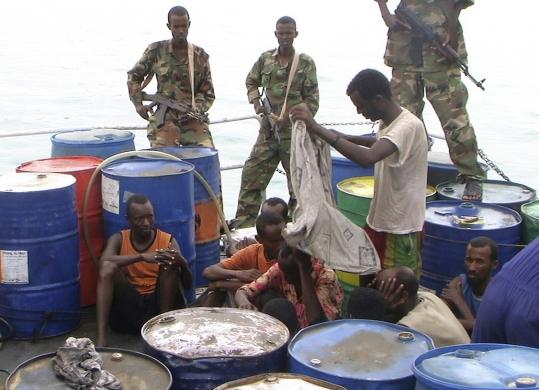
Arr! Pirates off the port bow!
News of a supertanker getting hijacked by pirates off the coast of East Africa has dominated international headlines this week. Pirates? If you haven't been paying attention, you can be forgiven for thinking that bearded men with wooden legs were terrorizing the high seas.
Last week, pirates succeeded in hijacking the Sirius Star, an enormous oil tanker carrying two million barrels of oil from Saudi Arabia. The ship's 25 crewmembers and cargo, worth more than $100 million, are being held for ransom. This event has sparked panic in global commodities markets, as if the world's economy needed more problems. According to the pirates though, it's the world's economy and the pollution it creates that gives them grief.
For the past six months, modern-day Somali pirates have been hijacking cargo ships passing through the narrow waterways between Somalia and Yemen. These pirates are mostly poor, ex-fishermen accompanied by the odd computer geek and strongman. The fishermen navigate and pilot the ships while the techies maintain the GPS and other high-tech equipment necessary for each pirate mission. The strongmen, armed with AK-47s, hijack the ships with the aid of speedboats. The pirates mostly refrain from violence though.
Countries like Saudi Arabia and India make the pirates out to be villains looking to score a quick profit and wreak anarchy. Well, what's wrong with a little anarchy?
The West's thirst for oil has brought the entire world to the brink of environmental and economic disaster. Any move that disrupts the oil trade and forces governments to shift towards renewable sources of energy is a positive one.
There's also the untold story of Somalia's ravaged shorelines. The shipping traffic that passes off the country's coast from the Gulf of Aden and the Red Sea has left large tracts of Somalia's coast heavily contaminated.
Without international concern, the pollution never gets cleaned up and it is the local inhabitants who suffer. In fact, the pirates insist that its the pollution and general indifference from the rest of the world that spurs them on, not ransom money.
But the real tragedy here is Somalia itself. Without a functional government for almost two decades, Somalia's problems have been deliberately ignored by Western nations and have now come back to haunt us.
It's only when the West's own selfish interests in oil and trade routes are threatened that the global eye shifts towards this failed state. It shouldn't have to take the reckless actions of a desperate few for the world's leaders to take notice of Somalia.
The ultimate lesson for us all is that poverty and suffering on the other side of the world is our problem too. Somalia's problems may seem far away, but if this episode teaches us anything, it's that we cannot afford to ignore the suffering of others anywhere in the world. To continue to do so is to invite these problems to our own doorstep in the form of hijacked ships, or worse, hijacked planes.
=//Turnquest
No Time for a Honeymoon
The easy part is over. Barack Obama succeeded in transforming his mantra from "Yes We Can" into "Yes We Did." After an endless campaign, in one giant sigh of relief, Americans made history. Yes, that sense of emptiness you're feeling is called election withdrawal. Now comes the hard part.
Let's set aside Obama's campaign promises for a while. For now, there are crises that need to be dealt with. Facing him is a plethora of issues threatening America and the world. Some of these are of such magnitude that any one of them could wholly consume a president's time. His is a job I wouldn't wish upon my worst enemies.
At the top of Obama's agenda is the financial crisis. His current plan focuses on helping those worst affected: the middle-class. This is laudable. It remains uncertain however whether the President and Congress can have much impact on the inherent structural problems in the global financial system. If there's money to be made, even imaginary money, can regulation really constrain the bloodlust of CEOs and speculators? After all, new laws mean new loopholes.
Then there's Iraq. In a New York Times op-ed piece published in July 2008, Obama wrote that on his first day in office, he would order the military to end the war. This goal would be accomplished by steadily withdrawing all combat troops within 16 months. With all the news generated by the economy, it's easy to forget that Obama's campaign was launched on the basis of his opposition to the war. His final decision regarding this issue is crucial, as it will be the litmus test that proves whether he can keep his word or not. Ending the Iraq War will save the United States vast amounts of money, build credibility abroad and save thousands of Iraqis from a terrible fate.
Once these current crises have been tempered, the President-elect will need to tackle climate change. Reconciling the scientific community with a once-hostile White House must be his first step. Obama's ambitious energy plan targets both America's growing carbon dioxide emissions and its energy shortage, but will also reform a lax culture of conservation, which is just as crucial. His solution is to invest heavily into green infrastructure and renewable sources of energy. Dubbed the Apollo Program's modern equivalent, the plan's goals are nothing less than slashing carbon dioxide emissions by 80 per cent by 2050 and eliminating America's dependence on Middle East oil in 10 short years.
To make matters worse, underwriting all these huge policy initiatives is a wounded, angry Republican party. Though thoroughly trounced in last week's election, the GOP is going to make sure they throw every obstacle into President Obama's path.
This column has thus far been a downer and admittedly so; it hasn't even mentioned America's failing health care system, its aging population, immigration policy, education, the budget deficit, Iran or Afghanistan. Then again, aren't these challenges the very reason so many millions backed Obama in the first place? Americans asked for leadership, vision, integrity, courage and yes, hope. "Yes we can" Barack Obama. The question now is "Can you too?"
=//Turnquest
Let's set aside Obama's campaign promises for a while. For now, there are crises that need to be dealt with. Facing him is a plethora of issues threatening America and the world. Some of these are of such magnitude that any one of them could wholly consume a president's time. His is a job I wouldn't wish upon my worst enemies.
At the top of Obama's agenda is the financial crisis. His current plan focuses on helping those worst affected: the middle-class. This is laudable. It remains uncertain however whether the President and Congress can have much impact on the inherent structural problems in the global financial system. If there's money to be made, even imaginary money, can regulation really constrain the bloodlust of CEOs and speculators? After all, new laws mean new loopholes.
Then there's Iraq. In a New York Times op-ed piece published in July 2008, Obama wrote that on his first day in office, he would order the military to end the war. This goal would be accomplished by steadily withdrawing all combat troops within 16 months. With all the news generated by the economy, it's easy to forget that Obama's campaign was launched on the basis of his opposition to the war. His final decision regarding this issue is crucial, as it will be the litmus test that proves whether he can keep his word or not. Ending the Iraq War will save the United States vast amounts of money, build credibility abroad and save thousands of Iraqis from a terrible fate.
Once these current crises have been tempered, the President-elect will need to tackle climate change. Reconciling the scientific community with a once-hostile White House must be his first step. Obama's ambitious energy plan targets both America's growing carbon dioxide emissions and its energy shortage, but will also reform a lax culture of conservation, which is just as crucial. His solution is to invest heavily into green infrastructure and renewable sources of energy. Dubbed the Apollo Program's modern equivalent, the plan's goals are nothing less than slashing carbon dioxide emissions by 80 per cent by 2050 and eliminating America's dependence on Middle East oil in 10 short years.
To make matters worse, underwriting all these huge policy initiatives is a wounded, angry Republican party. Though thoroughly trounced in last week's election, the GOP is going to make sure they throw every obstacle into President Obama's path.
This column has thus far been a downer and admittedly so; it hasn't even mentioned America's failing health care system, its aging population, immigration policy, education, the budget deficit, Iran or Afghanistan. Then again, aren't these challenges the very reason so many millions backed Obama in the first place? Americans asked for leadership, vision, integrity, courage and yes, hope. "Yes we can" Barack Obama. The question now is "Can you too?"
=//Turnquest
2008/11/17
Why George W Bush Might Go to Heaven

"Barack Obama! Change! Wooooo!" A recent episode of South Park featured Randy, Stan Marsh's irrepressible dad, celebrating Barack Obama's electoral victory by drinking himself into a stupor. The episode highlighted a certain trend lately of people blindly supporting the first black President. The flip-side to this, of course, is a massive chorus of scorn for the still-current president George W. Bush. The most commonly used slur against W is that he's dumb.
Dumb? Please. The man has an MBA from Harvard and a bachelor's degree from Yale. Call him a failure, misguided, a son of privilege or even a puppet, but 'dumb' isn't a term you can use for a guy who got himself elected to the White House. Twice.
Take a look at the positive side (yes, there is a positive side) of W for a moment. If there's one good thing to be said about him, it's that he kept America safe from further terrorist attacks. Yes, the cost was heavy. To achieve this goal, he employed several dubious and often illegal means such as mass wiretapping, extraordinary rendition, torture and two bloody wars. Nevertheless, the end result was seven terror-free years of security.
Even Bush's harshest critics cannot discount his leadership in the battle against the AIDS pandemic in sub-Saharan Africa. After witnessing the tragic horrors that the virus has visited upon the region, he backed up his words with cash - this year alone, he authorized $39 billion over the next five years to fight AIDS, on top of the $15 billion he authorized in 2003. Because of American investments, nearly two million people today have access to anti-retroviral drugs and millions of orphans have received life-saving treatment and care. The United States is the leading donor to the Global Fund to Fight AIDS, Tuberculosis and Malaria. This is all W's doing.
On the timely issue of immigration, W went against the most fervent, xenophobic elements of the Republican Party and opposed the detention and deportation of millions of illegal immigrants in the United States. Instead, he offered a path to citizenship and integration into society for undocumented workers. Though the bill was defeated in Congress, his stance on the issue saved the country from a potentially disastrous attempt to deport over twelve million people.
At the least, W returned basic dignity to the office of the President. Bill Clinton's philandering had besmirched the institution of the Presidency when W came to office in 2001. Many of us can recall the incessant jokes about interns and the President on late-night TV.
These days, while it's oh-so-hip to be an Obama-lovin,' W-hatin' leftist, in politics, there is always more to the issues than one-sided ideology. The awful truth is there had to be a George W Bush before there could be a Barack Obama. Don't mistake my position. From Iraq to the Patriot Act, climate change to Palestine, there's just no defending most of his decisions as President. My point is though you may never agree with George W. Bush, one day, you just might forgive him.
=//Turnquest
2008/11/04

McCain concedes
McCain to concede around 11pm EST
http://www.dailykos.com/storyonly/2008/11/4/185520/135/920/653021
It's 10:59 PM EST, FoxNews has it live on their channel that Obama has 297 electoral votes.
It's over.
=//Turnquest
http://www.dailykos.com/storyonly/2008/11/4/185520/135/920/653021
It's 10:59 PM EST, FoxNews has it live on their channel that Obama has 297 electoral votes.
It's over.
=//Turnquest
2008/10/19
Powell on Obama
Colin Powell delivers his endorsement of Barack Obama with such eloquence, it almost makes up for the fact that he helped to start the war in Iraq. Almost. BONUS: He defends Islam too!!!
=//Turnquest
=//Turnquest
2008/10/14
Barack Media
You'd think with just three weeks to go till THE BIG DAY I'd have a lot more posts. Well, I'm a bastard. Anyway, I haven't been entirely silent; check out some unabashedly partisan and hit-baiting posts over on DailyKos:
http://turnquest.dailykos.com/
and look at this photo:

and watch this video:
=//Turnquest
http://turnquest.dailykos.com/
and look at this photo:

and watch this video:
=//Turnquest
2008/09/12
Sharper Tone
 Sen. Barack Obama & Sen. John McCain hug following a National Service conference at Columbia University in New York City, Sept. 11, 2008.
No reason to 'fret.' This kind of American-made cesspool politics always rears its head as we get closer to the big day (less than two months...) The key statements are by David Plouffe and David Axelrod, Obama's mastermind campaign managers who sound as cool and under control as ever. And why should we doubt the men who beat the most formidable political family in politics and their predestined nominee (the Clintons)?
Hold it down folks...McCain is no Hillary. Obama will win.
Obama Plans Sharper Tone as Party Frets
http://www.nytimes.com/2008/09/12/us/politics/12obama.htmlSenator Barack Obama will intensify his assault against Senator John McCain, with new television advertisements and more forceful attacks by the candidate and surrogates beginning Friday morning, as he confronts an invigorated Republican presidential ticket and increasing nervousness in the Democratic ranks.
Mr. McCain’s choice of Gov. Sarah Palin of Alaska as his running mate and the resulting jolt of energy among Republican voters appear to have caught Mr. Obama and his advisers by surprise and added to concern among some Democrats that the Obama campaign was not pushing back hard enough against Republican attacks in a critical phase of the race.
Some Democrats said Mr. Obama needed to move to seize control of the campaign and to block Mr. McCain from snatching away from him the message that he was the best hope to bring change to Washington.
After back-to-back attack ads by Mr. McCain, including one that misleadingly accused Mr. Obama of endorsing sex education for kindergarten students, the Obama campaign is planning to sharpen attacks on Mr. McCain and Ms. Palin in an effort to counter Mr. McCain’s attempt to present himself as the candidate of change with his choice of Ms. Palin.
The new tone is to be presented in a speech by Mr. Obama in New Hampshire and in television interviews with local stations in five swing states, backed up by new advertisements and appearances across the country by supporters.
In addition, advertising themes will be pay equity for women, an issue that has particular resonance as the campaigns battle for female voters, and a more pointed linking of Mr. McCain to President Bush and Republicans in Washington.
But Mr. Obama’s aides said they were confident with the course of the campaign. They said that, other than making some shifts around the edges, particularly in response to Mr. McCain’s effort to seize the change issue from Mr. Obama, they were not planning any major deviation from a strategy that called for a steady escalation of attacks on Mr. McCain as the race heads toward the debates.
That response is characteristic for a campaign that has presented itself as disciplined and unflappable and is reminiscent of the way Mr. Obama’s campaign reacted a year ago when it came under fire from allies who said it was not being tough enough in going after Senator Hillary Rodham Clinton.
“We’re sensitive to the fluid dynamics of the campaign, but we have a game plan and a strategy,” said Mr. Obama’s campaign manager, David Plouffe. “We’re familiar with this. And I’m sure between now and Nov. 4 there will be another period of hand-wringing and bed-wetting. It comes with the territory.”
Still, Democrats outside the campaign suggested Mr. Obama should be urgently working to regain control of the message.
“The Obama message has been disrupted in the last week,” said Representative Artur Davis, Democrat of Alabama. “It’s a time for Democrats to focus on what the fundamentals are in this election.”
Phil Singer, who was a press secretary for Mrs. Clinton in her primary campaign against Mr. Obama, said, “The Obama people need to reboot and figure out ways to make the McCain-Bush argument newsworthy again.”
The uneasiness among Democrats is the result of a confluence of factors in the week since Mr. McCain accepted his party’s nomination in St. Paul. The selection of Ms. Palin became the defining event of Mr. McCain’s convention, revving up the conservative base and drawing the spotlight away from Mr. Obama.
Mr. McCain’s increasingly aggressive campaign has sought to put Mr. Obama on the defensive in each news cycle, using any development at hand, like Mr. Obama’s colloquial comment this week about putting “lipstick on a pig,” to keep attention away from Democratic messages about the economy and the similarities between Mr. McCain and Mr. Bush.
And a series of quick polls taken after the Republican convention have suggested that Mr. Obama has lost support among white women and independent voters. Polls taken so close to major political events are notoriously unreliable, but Democrats remember what happened in 2004, when Republicans used the period right after Senator John Kerry’s nomination to undercut him with a series of attacks.
By every indication, Mr. Obama’s aides underestimated the impact that Mr. McCain’s choice of Ms. Palin would have on the race. Mr. Obama and his campaign have seemed flummoxed in trying to figure out how to deal with her. His aides said they were looking to the news media to debunk the image of her as a blue-collar reformer, even as they argued that her power to help Mr. McCain was overstated.
“Everyone was astonished that she drew 9,000 people to Lancaster the other night,” said Mr. Obama’s senior strategist, David Axelrod. “But we drew 10,000 people there last week.”
“They got a transient boost from the sort of imagery surrounding her selection,” Mr. Axelrod said. “But I think things will settle in. She will be a candidate and not just a symbol.”
Beyond that, Mr. Obama’s aides said they had been taken aback by the newfound aggressiveness of the McCain campaign under Steve Schmidt, who has played an increasingly powerful role since last summer. Even as the aides have denounced the tactics as unsavory, they acknowledge that Mr. McCain is running a more effective campaign than he was a month ago.
“They had big problems in their campaign, and they made adjustments,” Mr. Axelrod said.
To a large extent, the perception that Mr. Obama is struggling is based on national polls taken in the days after the convention. But Mr. Obama’s campaign views such measures as irrelevant and focuses on what is going on in the 18 or so swing states.
Mr. Plouffe argued that the attention being paid by national news media outlets to events like Mr. Obama’s lipstick comment was not mirrored in local news coverage. What is more, the Obama campaign has filled the airwaves in some states with advertisements that link Mr. McCain and Mr. Bush.
And for all the concern voiced by Democrats to Mr. Obama’s aides that the candidate has not hit Mr. McCain hard enough, he has increasingly assailed Mr. McCain in recent days, mocking his attempt to present himself as an agent of change and denouncing his campaign style as a break from the promise he had made to practice a new kind of politics. Yet, at least on television, Mr. Obama’s critique did not break through the lipstick debate.
Inside the campaign headquarters in Chicago, aides said, there have been no emergency conference calls or special strategy sessions to deal with the new dynamic in the race.
Still, interviews with advisers and supporters suggested a concern not seen in the Obama campaign since its most competitive days in the long primary fight with Mrs. Clinton.
“You can’t be so stubborn that you don’t react or adjust to events,” Mr. Plouffe said. “We have been given up for dead any number of times in this process, so it does stiffen your spine a little bit.”
One adjustment for the Obama campaign comes as Mr. McCain is seeking to claim the Democrats’ theme of change by pointing to Ms. Palin. For months, advisers to Mr. Obama had assumed that Mr. McCain would play up his experience; Mr. Plouffe said he welcomed what he argued would be a campaign fought out on the issue of change.
“This is a very major development,” Mr. Plouffe said. “John McCain jettisoned his message and his strategy. It is now about change. We’re going to lean into that very, very hard.”
In the midst of all this, Mr. Obama had a private lunch on Thursday with someone he battled with for much of the year but who knows how to put the Republicans on the defensive: former President Bill Clinton. Discussion topics, aides said, included how Mr. Obama might handle Ms. Palin in the days ahead.
=//Turnquest
2008/09/06
Clippings 2003-2005
Right, no posts in a month, no excuse right right.
And even this isn't much of a real post, but fuck it, *I* find it fascinating. ::::
It's a giant list of clippings I collected from 2003 to 2005 from all manners of internet sources. It's mostly news/politics oriented and totally random. Some of the entries are single words (Ashkelon), others are longer and more easily traceable. Overall, it's an interesting read and simultaneously offers insight into the mind of the authour, and of the world at large.
En guarde!
* * *
And even this isn't much of a real post, but fuck it, *I* find it fascinating. ::::
It's a giant list of clippings I collected from 2003 to 2005 from all manners of internet sources. It's mostly news/politics oriented and totally random. Some of the entries are single words (Ashkelon), others are longer and more easily traceable. Overall, it's an interesting read and simultaneously offers insight into the mind of the authour, and of the world at large.
En guarde!
* * *
Clippings
Disconnected from their past in the Muslim world and uncertain about their future in Europe, they've come to see themselves as citizens of nothing but "Neuf-trois," 93, the postal code for the outer edges of the Paris urban area.
NAIROBI (Reuters) - Pirates fired rocket-propelled grenades and machine guns at a U.S.-owned cruise ship carrying more than 300 people in the Indian Ocean on Saturday but the vessel escaped and no one was hurt, its owners said.
The attacks highlight insecurity in Somalia, without a government since warlords ousted dictator Mohamed Siad Barre in 1991.
*
If the deadly bird flu simmering in Southeast Asia boils up into a pandemic, demand for influenza vaccines will explode. So will Crucell's stock price.
- Fortune Analysis
*
Fitzgerald appeared prepared to indict Rove heading into last week for making false statements, according to three people close to the probe. But that changed during a private meeting last Tuesday between Fitzgerald and Rove's attorney, Robert Luskin. It's not clear precisely what happened in that meeting, but two sources briefed on it said Luskin discussed new information that gave Fitzgerald "pause."
That evening, Fitzgerald's investigative team called Adam Levine, a member of the White House communications team at the time of the leak. An investigator questioned Levine about an e-mail Rove had sent Levine on July 11, 2003 -- the same day Rove discussed Plame with Time magazine reporter Matthew Cooper, according to Dan French, Levine's attorney.
The e-mail, which did not mention Plame, ended with Rove telling Levine to come see him. The investigator wanted details of that conversation, which took place within an hour or so of the Cooper-Rove chat, according to a person familiar with the situation. Levine told investigators they did not discuss Plame.
*
'You know me, you are an Iraqi,' Sadaam Hussein said to Judge Rizgar Mohammed Amin, who asked the former dictator to identify himself at his trial for crimes against humanity.
*
Many biographies focusing on members of the Wailers relate a specific incident where several people alleged that Tosh became enraged upon hearing that Marley was seeing a well known white woman in Kingston. He talked big and threatened both physical violence and damnation and hellfire for his friend, vowing to track him down and take him to task. Later that day Bob casually walked into a room where Peter was relaxing with some of their mutual friends but mysteriously McIntosh seemed happy to see him and made no mention of any misgivings about the controversial relationship. When Marley was eventually told the whole story he allegedly laughed and responded: "Petah? Fussin'? You don't say!"
*
The Daily Mirror tabloid printed images from a video which it said showed the model doing five lines of cocaine in 40 minutes at a late-night music recording session, preparing them with a credit card and snorting the drug through a five-pound note.
The newspaper said Moss had taken a large amount of cocaine out of her handbag. Her boyfriend Pete Doherty, the musician whose alleged drug problems and brushes with the law have made headlines for months, was also present, the paper reported.
The Mirror said Moss had shouted obscenities when one of its reporters asked her for comment on the allegations outside a restaurant in New York, where she was attending the city's Fashion Week shows.
*
"All over the country, stop cigarettes, stop fuckin' cigarettes. Up in San Francisco, the fag capitol of California, they passed a bill, you can't even smoke in the street. They say it offends people. But it's okay if you wanna butt-slam your buddy while waiting for the bus? You smack him in the face with your dick five or six times? Oh, this isn't offensive. You can smoke a baloney pony, but not a fuckin' Marlboro? Wiping your ass is a filthy habit but nobody's banning that. Oh look at him - he's smoking! Yeah, and I'm jerking off too, honey. Come a little closer, I'll butter your fuckin' popcorn."
*
Sinclair Broadcast Group, one of the largest owners of television stations in the country, has decided to preempt its regular network programming days before the Nov. 2 election to air an anti-John Kerry film, Stolen Honor: Wounds That Never Heal, the Los Angeles Times reported Saturday. David Wade, a spokesman for the Kerry campaign, told the newspaper: "It's beyond yellow journalism; it's a smear bankrolled by Republican money, and I don't think Americans will stand for it." Sinclair either owns or programs 62 television stations throughout the country. The same company ordered several of its stations last April not to air ABC's Nightline roll call of military dead in Iraq, calling it a political statement "disguised as news."
*
Most international Internet traffic is routed through the U.S. and through 9 known U.S. NSA interception sites.
3.24.00 AP Worldstream
*
P.S. for the FBI: All Likudniks are neocons, but not all neocons are Likudniks. It would be the better part of valor to give them a wide berth
*
"Many, but not all, think that the American army is invincible. But now it's appeared only truth is invincible," Sheik Jaber al-Khafaji said in a statement read on al-Sadr's behalf. "America claims to control the world through globalization, but it couldn't do the same with the Mahdi Army."
*
"They were on the street and they were filming protesters. The police came over and they ... gave them a couple of directions to scoot to the side," Andre said. "And they did everything police said and actually the policeman said, 'No, this is not an arrest, you're not getting locked up,' and two or three minutes later, then they started to say, 'Get down on the ground.' And they put these plastic things on people's hands ... and they shipped them off."
Andre 3000, half of the hip-hop duo OutKast, who came to New York to make a documentary about voter registration, was awaiting the release of two crew members who were arrested Tuesday.
*
CBS' Jerry Bowen took a mostly negative look at the Administration's plan to give hospitals $1 billion in aid so long as they begin to ask ER visitors whether they are legal immigrants or not.
*
10/26/65: Selective Service lifted ban against drafting childless married men.
1/19/66: Cheney applied for 3-A status; Lynne was roughly 10 weeks pregnant.
7/28/66: Cheney's daughter Elizabeth was born -- nine months and two days after the ban on drafting childless married men was lifted. [Washington Post, 4/3/91]
*
The Secret Service, which has jurisdiction within Madison Square Garden during the convention, said the screening process is working and no one who has demonstrated inside the convention has had a weapon or posed a threat to anyone.
All of the hecklers had valid floor passes.
*
Mr. Kerry's running-mate, Senator John Edwards of North Carolina, issued a statement shortly after the Republicans adjourned, saying: "There was a lot of hate coming from that podium tonight. What John Kerry and I offer to the American people is hope."
*
Even before Sept. 11, 2001, he had signaled that he intended to govern ambitiously, ignoring the disputed circumstances under which he came to the White House. On that day that stunned him and the nation, Mr. Bush began learning in earnest about the lethal powers available to him as commander in chief. He soon sent soldiers off to fight in the mountains of Afghanistan and in the streets of Baghdad, and as the still-bloody battle rages in Iraq, he faces an electorate deeply divided over whether he rushed into war without adequate cause.
*
Miller said he supports George Bush because the president has "a good heart and a spine of tempered steel." The two met when both were governors and the Georgian appreciated the Texan for his religious beliefs and his straightforward manner.
*
Whatta paira charlies"!
*
KING: We're back with our remaining moments with President and Mrs. Bush. Sales tax over an income tax?
(CROSSTALK) KING: Wouldn't that hurt the middle class?
G. BUSH: Yes. Listen, the guy asked me a question. He said, "what about getting rid of the entire income tax system for an alternative?" I said it's an interesting idea. My point to him was was that we ought to explore ways to simplify the tax code.
KING: You weren't saying replace it with sales tax?
G. BUSH: No, I said it was an interesting idea. This is politics. People put words in your mouth. People shouldn't worry about me raising taxes. I'm the guy that cut taxes. I worked with Congress...
KING: But you wouldn't replace income with sales tax.
G. BUSH: Well, it's an option that some people think is a viable option. I just said it's an interesting idea. I do think we ought to look at ways to simplify the tax code. The tax code is way too complicated but let me just make this clear so everybody understands. I'm the guy that believes in reducing taxes and keeping them low. It's the other fellow that says he's going to raise taxes and I think it'll be a mistake to raise taxes now. The economy is getting better and raising taxes now on people would slow the economy down.
And I'll give you an example. I live two miles from the state of Connecticut. Connecticut is one of 17 states in which it is now unsafe to eat any freshwater fish in the state, because of mercury contamination. There's no...
HALPIN: That comes from power plants.
KENNEDY: It comes from power plants. There's no geological source of mercury in the state of Connecticut. It's coming from the power plants.
We know a lot about mercury. One out of every six American women now has so much mercury in her womb that her children are at risk for a grim inventory of diseases, including autism, blindness, mental retardation, permanent cognitive impairment.
I have so much mercury in my body — I recently had it tested — that Dr. David Carpenter, who is the national authority on mercury, told me that if a woman of child-bearing years had the same levels that I did, that she would have a child that would have permanent cognitive impairment.
Robert F. Kennedy Jr.
*
Now all the initial costs of a hurricane must be borne by customers along the Atlantic and Gulf Seaboard. In that huge sweep of territory, the insurers have begun imposing deductibles of one to five percent on policyholders in place of the widespread deductible of $500 that most homeowners in America choose. The result is that the owner of a $100,000 home with a 5 percent deductible pays the first $5,000 in losses rather than $500.
*
"If Israel behaves like a lunatic and attacks the Iranian nation's interests, we will come down on their heads like a mallet and break their bones," the ISNA students news agency quoted Revolutionary Guards Commander Yahya Rahim Safavi
*
Mr. Sadr has said that he would resist the American presence in Iraq "until my last drop of blood." His fighters, armed with rocket-propelled grenades, mortars and assault weapons, are confronting armored combat vehicles and heavy weapons of the American forces.
American forces and the guerrillas clashed over night, and residents in Najaf said that early today a column of American tanks entered the cemetery area, probing the path for a convoy of humvees that toured the city's streets, urging people through loudspeakers to leave the city center and nearby town of Kufa and sending a warning to fighters.
"People should cooperate with the Iraqi police and national guard," the message blared out in the streets. "There will be no truce and no negotiations with the corrupt armed militias. We ask you to evaluate the city center and Kufa."
"Leave the city in peace or you will die," the message said, naming districts to be evacuated, affecting about 75 percent of the city.
After the announcement, witnesses said they saw streams of cars heading out of the city. A huge fire billowed up from the direction of the city center. The crack of sporadic gunfire rang out.
Today, Ahmed Shaibani, an aide to Mr. Sadr, appealed for negotiations in a statement broadcast on the Arabiya television network.
"We are ready to accept any peace plan or negotiate to bring peace to the holy city and all over Iraq," he said. He added that the Mahdi army and the Islamic resistance control most of the central and southern governorates of the country, saying this "confirms the failure" of the occupying forces in Iraq.
...Residents in Sadr City say that American counter-fire, with cannons from Bradley combat vehicles and sniper fire, is indiscriminate.
*
But he told reporters on a campaign swing through Arizona, "I would have done this very differently from the way President Bush has." He challenged Bush to answer four questions.
"My question to President Bush is why did he rush to war without a plan to win the peace?" Kerry asked. "Why did he rush to war on faulty intelligence and not do the hard work necessary to give America the truth?
"Why did he mislead America about how he would go to war? Why has he not brought other countries to the table in order to support American troops in the way that we deserve it and relieve a pressure from the American people?
"There are four, not hypothetical questions like the president's, but real questions that matter to Americans," Kerry said. "And I hope you'll get the answers to those questions because the American people deserve them."
*
The desire to pursue a broader strategy against Iran's nuclear ambitions is driven in part, officials say, by increasingly strong private statements by Israeli officials that they will not tolerate the development of an Iranian nuclear weapon, and may be forced to consider military action similar to the attack against a nuclear reactor in Iraq two decades ago if Tehran is judged to be on the verge of deploying a weapon. (In contrast, North Korea's neighbors, especially South Korea and China, are seeking stability first, and disarmament as a longer-term goal, diplomats from the region say.)
*
“A machine of wide and elaborate contrivance and as well fitted for the oppression, impoverishment and degradation of a people as ever proceeded from the perverted ingenuity of man.”
Edmund Burke
*
"We have a joke here," he adds. "In America, you find out who wins the elections two months after they've finished. In Russia, we know two months beforehand."
*
8. Nearly every political reporter in America is having the same experience — they keep finding Republicans who say they will never vote again for President Bush (over the the war and the deficit, usually) but they have a heck of a time finding anyone who voted for Gore in 2000 who are now certain that they will vote for Bush (and Gore apparently won the popular vote).
*
1. Whoever wins the electoral votes of 2 out of 3 (or 3 out of 3) of Ohio, Pennsylvania, and Florida will be the next president of the United States.
*
The Pentagon and the coalition spokesman identified the missing Marine as Cpl. Wassef Ali Hassoun with the 1st Marine Expeditionary Force, but the Pentagon said it could not confirm that he was the man shown in the video.
The videotape showed a man dressed in military fatigues wearing a blindfold. A person standing off-camera held a sword above the man's head. Al-Jazeera also showed what it said were Hassoun's identification papers.
*
In 1974, George spent Superbowl Sunday at a party hosted by Hunter S. Thompson. When asked decades later if he remembered whether Bush had used any drugs at his party, Thompson replied:
"I can't be expected to remember what every drug-addled yuppie hanger-oner who wanted to get close to me during a football game twenty-five years ago digested. There were so many dope fiends milling about, I don't remember what some Yalie named Bush, whose father was a factotum in the Nixon Administration, was doing. But he strikes me as the sort of person I would have thrown out of the room. A rich, beer-drunk yahoo with a big allowance who passes out in your bathtub. ... I don't want to become the Deep Drug Throat. ... I won't do it."
*
On Tuesday, Cheney, serving in his role as president of the Senate, appeared in the chamber for a photo session. A chance meeting with Sen. Patrick J. Leahy (Vt.), the ranking Democrat on the Judiciary Committee, became an argument about Cheney's ties to Halliburton Co., an international energy services corporation, and President Bush's judicial nominees. The exchange ended when Cheney offered some crass advice.
"Fuck yourself," said the man who is a heartbeat from the presidency.
*
"I have no doubt that our great-grandchildren will routinely use space elevators,"
*
AFGHANISTAN
The United States has vowed to crush militants this year with a combination of stepped-up military operations and reconstruction aid to Afghan villagers, who commanders hope will provide crucial intelligence on enemy movements.
But the military has been unable to halt violence that has killed more than 500 people so far this year, threatening plans to hold national elections in September.
Workers helping organize those elections have been targeted with roadside bombs. In May, an explosion hit a car carrying Afghan election workers in Kunar province, injuring all four people inside, two of them seriously.
*
"As for you Allawi, the supposedly democratically elected prime minister, we have prepared something very special for you," the voice on the tape said.
"We have prepared a special poison for you and a sharp sword and we have filled a glass for you and we have filled a glass with death especially for you.
"You don't even know how you have repeatedly escaped from our many attempts, but we promise you we will continue the match with you until the end," the voice said.
*
"Kerry doesn't have to win North Carolina to win the presidency. Everybody knows that. Bush knows that. But by taking Edwards on the ticket, it really does force Bush to spend time in an area that, frankly, he can't afford to spend time in," says the pollster who conducted the survey.
*
"'It was dark down there,' Clinton writes of his inner turmoil. As a junior in high school, Clinton wrote that 'I sometimes question the sanity of my existence.'"
*
The [9/11] commission said that controllers at the FAA's Boston Center, in New Hampshire, first realized there was a problem at 8:21 a.m., when American Airlines Flight 11 turned off its transponder, which relays information about the plane's identity and location.
At 8:24:38 a.m. the following transmission was received from Flight 11:
"We have some planes. Just stay quiet, and you'll be O.K. We are returning to the airport." The controller was not sure what he heard except "We have some planes."
A few seconds later, controllers picked up another transmission:
"Nobody move. Everything will be OK. If you try to make any moves, you'll endanger yourself and the airplane. Just stay quiet."
The Boston Center then alerted the FAA of the hijacking, as called for in the protocol for handling hijackings.
The center also warned military air officials, who got the word at 8:37:52 a.m., just nine minutes before Flight 11 crashed into the World Trade Center's north tower.
"The nine minutes notice was the most the military would receive that morning of any of the four hijackings," the report found.
NORAD's Northeast Air Defense Sector (NEADS) notified officials at Otis Air Force Base, which is about 153 miles from New York City, and a colonel at the base began to seek authorization to scramble the two F-15 fighters it had on alert.
The report said that Maj. Gen. Larry Arnold told the colonel "to go ahead and scramble the airplanes and we'd get permission later."
The fighters were scrambled at 8:46 a.m., but since they were unable to locate the plane, authorities did not know where to send them. They were not in the air until 8:53 a.m.
As this drama unfolded, air controllers struggled as they received indications that three other planes were missing.
Later, Cheney communicated authorization for civilian planes to be shot down if they threatened strategic targets, but that order was not received until Flight 93, the last of the four hijacked airplanes, crashed in a field in Shanksville, Pennsylvania.
Thursday's hearing is the last public meeting of the commission before it releases its final report, which is due at the end of next month.
*
His work involved transmitting characteristics between pairs of beryllium atoms, while the Austrian work used pairs of calcium atoms. Each atom's "quantum state," a complex combination of traits, was transmitted to its counterpart.
Key to the process was a phenomenon called entanglement, which Einstein derided as "spooky action at a distance" before experiments showed it was real.
Basically, researchers can use lab techniques to create a weird relationship between pairs of tiny particles. After that, the fate of one particle instantly affects the other; if one particle is made to take on a certain set of properties, the other immediately takes on identical or opposite properties, no matter how far away it is and without any apparent physical connection to the first particle.
*
MADRID, Spain - Bodyguards for President Bush (news - web sites)'s daughter were entangled in a fist fight with two men trying to steal a cell phone in southern Spain, a U.S. Embassy official said Tuesday.
The fight happened last Thursday while Jenna Bush was vacationing with some friends in the coastal city of Tarifa, continental Europe's southernmost point and a famous destination for wind surfers, embassy spokesman John Law said.
The 22-year-old Bush was sitting at a hotel terrace when two men tried to steal a cell phone on a nearby table. Law said it wasn't clear to whom the cell phone belonged, but Bush's bodyguards reacted immediately.
One secret service agent punched one of the suspects in the mouth, Law said, adding that he had no other details of the altercation.
He could not confirm reports by state news agency Efe that one of the secret service agents pointed his gun at a suspect.
Jenna Bush was not hurt and did not press charges against the men, who were not arrested, Efe reported.
*
Though 'trade' covers a vast array of products and services both tangible and intangible, four component parts are especially important at the dawn of the twenty-first century. The absolute control of life and death is represented by the pharmaceutical and aerospace-defense conglomerates, while generic tourism in one form or another leads the charge in securing vast sums of transient currencies, and in capturing the 'hearts and minds' of an increasingly mobile global public. None of the above would be able to operate without crude oil, which is therefore the fourth of these important components.
- joe vialls
*
The most frequent complaints are that there are far more men online than women and a lack of protection against sexual predators or cheating lovers, said Michael Kantor, an information technology project manager in Arlington, Virginia, who runs the site.
"Men lie about their availability, whether they have a steady girlfriend or wife, and women tend to lie mostly about their looks," Kantor said.
*
IRAN-CONTRA
The administration in 1984 secretly sold arms to Iran -- which the United States considered a supporter of terrorism -- to raise cash for Nicaraguan contra rebels, despite a congressional ban on support for the Latin American insurgency. An independent investigation concluded that the arms sales to Iran operations "were carried out with the knowledge of, among others, President Ronald Reagan [and] Vice President George Bush," and that "large volumes of highly relevant, contemporaneously created documents were systematically and willfully withheld from investigators by several Reagan Administration officials."
*
Following in the footsteps of the Democratic Carter administration, Reagan surreptitiously supported mujaheddin rebels in Afghanistan in their prolonged battle against occupying Soviet forces. As part of that initiative, the CIA supported Muslim radicals from other Islamic countries. One of the first non-Afghan volunteers to join the ranks of the mujaheddin was Osama bin Laden.
*
And the first duty of a commander in chief is to make America strong and keep Americans safe. A week ago in Seattle, I outlined a new strategy of national security based on four imperatives. First, we must lead strong alliances for the post 9-11 world. Second, to secure our full independence and freedom, we must free America from its dangerous dependence on Mideast oil. Third, in addition to our military might, we must deploy all that is in America's arsenal--our diplomacy, our intelligence, our economic power, and the power of our values and ideas.
And fourth is the imperative I will discuss today: We must modernize the world's most powerful military to meet new and different threats. The Bush Administration was right to call for the "transformation" of the military. But their version of transformation was directed at fighting classic conventional wars, rather than the dangers we now face in Iraq, Afghanistan, and in the war against al Qaeda. To rise to the challenges we face, we must strengthen our military, including our Special Forces; improve our technology; and task our National Guard with Homeland Security.
- Senator John F. Kerry, June 3, 2004
*
Ronald Reagan was the greatest leader of the free world in the 20th Century. Franklin Delano Roosevelt left Europe half enslaved. Churchill left Britain in economic decline. Ronald Reagan both defeated the Soviet Union and began a period of economic growth that has lasted a generation and continues to this very day."
- Grover G. Norquist, president of Americans for Tax Reform and chairman of the Ronald Reagan Legacy Projec
*
Al-Sadr's army will officially be outlawed Monday afternoon, according to a senior coalition official. His militia wasn't approached to take part in the new arrangement.
"No groups were excluded, other than by their own actions," the senior official added.
The new law also makes it illegal for al-Sadr to hold office.
*
Although I have no sources on-hand to prove what these are, I'm pretty sure the portrait is of the Comte de St.-Germain. St.-Germain was a mystical adept, a Rosicrucian, and some believe he never died. His true identity was rumored to be Prince Ragoczy of Romania.
*
The radical restructuring may have been decreed by what's called the Global Defense Posturing Review or GDR, the Pentagon's blueprint for the future of the U.S. armed forces.
*
Does the building of a bed precede the love act itself? Or can we 'do it in the road' until the people's army has satisfied our territory problem?
*
The G8 economic summit on Sea Island, Georgia, Fourth of July celebrations, the Democratic convention in Boston, the Republican convention in New York, the Olympics in Greece, and the November election are also seen as possible terrorist targets.
*
ASHKELON
*
Both Kerry and Bush have released negative ads slamming each other while at the same time saying they want to focus on the issues.
*
It's not clear yet, because there's lots of casualties. They are resisting, they are fighting, they are in large numbers," Suetan said.
He said the Pakistani forces were committed to "finish off the terrorists" and that within a day or two there might be "good news" to report. "You have to wait and see," he said.
*
Maj. Gen. Shaukat Suetan, Pakistani military spokesman, said human sources indicated a high-value al Qaeda leader was there.
Asked if it was al-Zawahiri, Suetan said with a smile, "Maybe, maybe."
*
Outside the church after yesterday's service, Johnny François kept a hand on his young son's shoulder and turned his back to a bitter wind. François came to the memorial because he feels a kind of connection: In 1991, his brother, Marcellus, was shot in the head by Montreal police, who thought he was someone else.
*
Reviewer: peter turesson from SWEDEN
Windir's first album ''soknardalr'' gave me a feeling about power and good performarce!
The songs were just perfect!
When ''arntor'' came too me i just can't believe it!
I thoyght it just can't be better....it can!
''1184''!!!
the album who beat up DIMMU BORGIR's ''stormblast'', cradle of filth's ''midian'' and immortal's heart of the winter!!!!
There mixure by blackmetal with great melodies and there folk style is the best i ever heard!
you must excuse my enlish...I'm from sweden...
I have always said that dimmu borgir is the kings of Norwegian blackmetal!
but i haved wrong!
WINDIR is the KINGS!
*
The executed Italian hostage was identified as Fabrizio Quattrocchi.
*
Thousands of U.S. troops will be deployed in a tribal area of northwest Pakistan in return for Washington's support of President Pervez Musharraf's pardon of the Pakistani scientist who this month admitted leaking nuclear arms secrets to Iran, Libya and North Korea, investigative reporter Seymour Hersh wrote in the issue that goes on sale on Monday.
Full disclosure of Pakistani scientist Abdul Qadeer Khan's activities would have exposed him as "the worst nuclear-arms proliferator in the world," an intelligence official is quoted as saying.
"It's a quid pro quo," according to a former senior intelligence official. "We're going to get our troops inside Pakistan in return for not forcing Musharraf to deal with Khan."
*
"Words cannot describe the emotion of anger and hate inside our hearts," said Hamas official Ismail Haniyeh, a close associate of Yassin in Gaza. He said that "the enemy should expect a response that will turn the ground under his feet to hell ... All of Palestine will turn into a volcano that will burn up the enemies."
*
I have not looked up to see the older man who is sitting in the row across from me at the greyhound station; nonetheless, his cane is tapping out a message coded especially for me. I am staring at the hands in my lap, mine. This is the second weekend that I have smoked opium, brown rock (a gift for which i am most grateful) presumably at one point extracted from Papaver somniferum. I had crushed and mixed it with tobbaco. The smell, taste, and buzz seemed correct. As I stared at my hands I became aware of how much time I spend in my life waiting. waiting for the bus, waiting to understand, waiting for things to make sense. waiting. How much my mind tries at times like these to organize its thoughts, even the things which can never be organized and must be accepted (as a storyteller leaves out the details which do not pertain).
On the way home I am acutely in tune with my surroundings. someone has got 'bells for her' coming very softly out of their car stereo. This too is a sign from synchronicity, perfectly dovetailing into my current life enigma. I am thinking on that old coot William S Burroughs, Jim Carroll, Aleister Crowley, famous and infamous junkies and fiends. I think on tea, and china. social mechanisms. How perfect this opium seems to make sense of my antisocial sides, my geometrically precise version of solitude. unapologetically selfish but hoping to offer some [help/beauty/rawmaterial].
Perhaps the most germane effect, for me, and what made this solitude worthwhile, is the sensation that i can hear things above and beyond what i normally would register. for example, I played a song to my companion hoping to point out a certain string section. However, we never quite made it to that point because we noticed an amazing phenomenon. In the song, an extremely faint one string, vibrated mercilessly throughout. it felt as though i could now experience subsonic and ultrasonic vibrations. yum. The aftertaste of opium is delicious to me and i am certain of its usefulness. uncomfortably certain. I am now more aware than ever of who in my life has taught me things, and who has learned from me or not learned from me. Just when i need to see it most, I see that not only *can* i rise above all occasions, but that I must, whenever possible, do so. I am recommitted to my mortal existence, to the fact that the social structure of the world holds an ideal to which it wont admit, to which i do not fit, and to which i am compelled to find creative ways of skewing.
Overall, the opium receptors in my brain were engaged to varying degrees for 48 hours after smoking. I hope in the future to experiment with a combination of opium and psychedelics.
*
"As with Nixon," noted Mr Dean, "the concept of executive privilege is being abused. This is about pure politics: do it as long as you can get away with it, and when you can't get away with it any more, yield."
*
"There is something about human beings that corporations can't deal with and that's our soul, our spirituality, who we are. We need to find a way in this country to understand-and to help each other understand-that there is a tremendous price to be paid for the supposed efficiency of big corporations. The price is losing the sense of who we are as human beings." (howard dean)
*
"Too many of our leaders have made a devil's bargain with corporate and wealthy interests, saying 'I'll keep you in power if you keep me in power.'"
"As long as half the world's population subsists on less than two dollars a day, the US will not be secure.... A world populated by 'hostile have-nots' is not one in which US leadership can be sustained without coercion."
"Over the last thirty years, we have allowed multinational corporations and other special interests to use our nation's government to undermine our nation's promise."
*
WASHINGTON (CNN) -- Secretary of State Colin Powell and other administration officials Monday sought to clarify questions raised in journalist Bob Woodward's provocative new inside account of the march to war in Iraq -- a book that nevertheless appears to have earned the White House seal of approval.
In an interview Monday in which he disputed suggestions by Woodward that he was out of the loop and dragooned into supporting President Bush on the war, Powell confirmed that the White House had told administration officials to cooperate with Woodward's "Plan of Attack."
"We all talked to Woodward. It was part of our instructions from the White House," Powell said. "It was an opportunity to help him write a contemporary history of this period."
Unlike the hostile treatment accorded recent tell-all tomes from former Treasury Secretary Paul O'Neill and counterterrorism adviser Richard Clark, Woodward's book received a generally positive reception at the White House. The president's campaign Web site even listed the book as "suggested reading," providing a direct link to order a copy from Amazon.com.
Debate continues over timing of war decision
Bush was one of 75 people interviewed by Woodward, who reported that the president ordered up secret plans for an invasion of Iraq in November 2001 and made the decision to go to war on his own, without soliciting the opinions of his vice president or secretaries of defense or state.
"It is, in a sense, the story of his presidency. This is the decision he made, he made it all alone. There was no committee vote," Woodward told CNN's "Larry King Live" on Monday. "He's the one who thought this story should be told."
But just when Bush made the fateful decision to go to war is one part of the book that is being disputed by the White House. Woodward said Bush made up his mind that war would be necessary in early January 2003 and then began telling his top advisers.
Both national security adviser Condoleezza Rice and White House Chief of Staff Andrew Card have said that the final decision to launch military action did not come until March, after Powell went to the U.N. Security Council in early February to make the administration's case for military action.
Woodward said he agrees with Card that the decision to go to war was not absolutely final until it became irrevocable as the March 19 invasion approached. But he told King that the source for his assertion that the actual decision was made earlier was the president himself.
Woodward said Bush told him that when he met in the Oval Office with Powell on January 13, 2003, it was "not a meeting to have a discussion. This was a meeting to tell Colin Powell that a decision had been made and that the president wanted his support."
=//Turnquest
Subscribe to:
Posts (Atom)


