2009/03/09

City of Miseries

City of Miseries

Montreal's Never-Ending Municipal Woes

This past week our long-time mayor Gerald Tremblay announced a surprise budgetary deficit of $150 million for the city. The implications of his announcement are that numerous city boroughs and municipal agencies have to patch up the difference. Bottom line: higher taxes for reduced services.

I don't about the rest of you, but I'm fed up with the horseshit being shoveled out of City Hall.

First of all, what's surprising about a deficit? Where was our guardian Tremblay when for the last 15 months everyone on Earth was shouting “recession?” Did we prepare any kind of a “rainy day” fund? No. Instead, we spent half a million dollars on a goofy crayon-coloured logo. The best-paid jobs in this city aren't construction worker or metro-booth lady; it's mayoral consultant.

Look, the way successful functional democracies are supposed to work is that the government's authority is to be kept in check by two mechanisms.

The first check is, of course, elections. Our electoral system here is already hopelessly flawed. The proof? According to a Leger Marketing study, Tremblay, our Bushian king, is polling at 32 per cent or 27 points above his closet rivals in the other municipal parties. So much for an informed public.

And who's fault is it that the public is so woefully complacent about the decline of our belle ville? The answer is the second of those asleep-at-the-wheel checks against abuse of power: the media.

Let's start with that flag-bearer of the English language, the Montreal Gazette. With its total obliviousness to reality, a dearth of investigate reporting and a weird, outdated obsession with sovereigntists, the Gazette has rendered itself more irrelevant than ever. The Journal de Montréal's writers are on strike. And our nightly newscasts are either kept to 22 minutes (with 15 of those minutes dedicated to sports, entertainment and the weather), or have simply been taken off the air (see: TQS).

On second thought, thank God our media is utterly inept because if we had any kind of decent news coverage, the entire world would learn the full extent of how far Montreal's fallen into a disgraceful rut.

The third-world quality streets, the bloated, corrupt bureaucracy, the ancient, collapsing infrastructure, 40-year old metros, the mind-numbing traffic, smog, fascist police who protect their own (even while killing 18-year-old kids), abject poverty in every part of the city except Westmount, TMR and Cote-St-Luc/Hampstead . . . I could go on and I'm sure you could to.

How about that “Quartier des Spectacles” Mr. Tremblay? Why can't the AMT trains run on time? Why isn't there a metro line anywhere west of Decarie? Is there any kind of functioning green policy? What's happening with that wasteland-cum-superhospital next to Vendôme metro? The Cinema V in N.D.G.? Will we ever have water mains that don't explode every time the temperature drops below zero, or snow-clearing operations that don't take three weeks to complete?

Personally, I'd be content with a simple extension of the metro system until four a.m. on Saturday nights. But that's just as unlikely as somebody defeating Tremblay in this November's election.

For what is supposed to be a cosmopolitan (a clichéd adjective for our city if there ever was one) North American city, we seem to not only tolerate all the shit shoved down our throats by our politicians and civil servants; we enjoy it.

It's so easy to lay the blame for the state we're in now on any number of declining institutions, socio-cultural factors or other levels of government, but the real target of our indignation has got to be primarily ourselves.

With complacency comes a lack of vigilance. And that, to misquote the old maxim, is the price of responsible government.

=//Turnquest

2009/01/13

GazaGazaIsrael


The first in a number of annoying columns about the situation in the Middle East:

Just to be clear from the start, what's happening over in Gaza is not a 'war' nor a 'conflict'; it is a massacre.

Let's do away with the analogies and reasoning. If there is one clear rule in war anymore, it is to not target civilians. What did Israel think was going to happen when they started dropping thousands of pounds of bombs on to apartment blocks, schools and housing projects in one of the most densely populated areas in the world? Where is the term 'collective punishment' to be found in a supposedly enlightened democracy's vocabulary?

As of this writing, 820 people had been killed in Gaza, half of them civilians and a third children.

There is no imminent threat to Israel's status. Hamas' rockets kill less people per year than meteorites or lightning strikes. Even its most bitter enemies admit that the Jewish state is not being 'wiped off the map' any time soon. So why launch such a devastating, brutal war on a mostly civilian populace?

The cynical answer is the forthcoming election. More on that in a future column.

For now, I wanted to discuss what I see as the most egregious issue that has emerged during this crisis; that of the inability of the international community to put a stop to the offensive. The meaning of the already vague term 'international community' has been rendered meaningless. The events and escalations over the past month are proof positive that the 'international community' is a toothless non-entity; a theoretical concept to be discussed in political science classes but with no relevant practical role in the real world.

The EU, NATO, the United Nations, Russia, China, these supposed global powers have not been able to prevent 'all-out war' in Gaza, nor have they been able to broker talks or settle any of the innumerable issues both sides are fighting about. It's these root causes that are most crucial in improving the situation. What will be the status of Jerusalem? Will the Palestinian diaspora ever be allowed to return?Can a Palestinian government ever guarantee that Israel will be safe from any attacks launched from its soil?

Stretching my argument back to the days of 9/11 and the War on Terror, the international powers were totally powerless in their opposition to the War in Iraq, towards wrestling control over carbon emissions and fighting climate change, in coordinating effective responses to the Darfur catastrophe, or even in preventing the current financial crisis.

My question is thus: If they can't do any of these things right, what good are they?

Can anyone make a persuasive argument for giving any supposed international 'power' creedence?

Despite much talk of the globalization of power, the rise of second-tier states and our entrance into a multi-polar, economic-fueled, soft-power political era, the world still is utterly helpless in the face of crisis.

If it were not for one nation with the economic, military and political power to enact real change and influence on the rest of the world, the world would be a free-for-all.

The EU may have growing political power. East Asia and the Gulf States may have vast amounts of financial clout. And Russia and Canada may have the natural resources. But When it comes down to it, more than any of these things, it is the political will and military capability of the United States that can stop wars, prevent financial chaos, save people from genocide or famine and impose a sense of security and stability.

Understandably, this is a bitter pill to swallow for most leftists and Bush-bashing anti-imperialists. Admitting that places like Palestine, Afghanistan and South Ossetia need the help of the United States is difficult, but who else could possibly intervene?

My concluding point is: a global hegemon, or world power, is not often liked, but it is often needed.


=//Turnquest

2008/11/26

Pirates!


Arr! Pirates off the port bow!

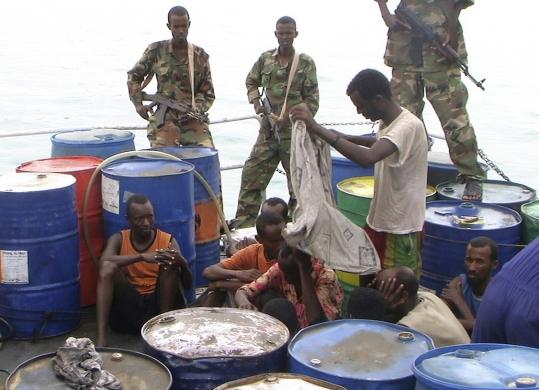
News of a supertanker getting hijacked by pirates off the coast of East Africa has dominated international headlines this week. Pirates? If you haven't been paying attention, you can be forgiven for thinking that bearded men with wooden legs were terrorizing the high seas.

Last week, pirates succeeded in hijacking the Sirius Star, an enormous oil tanker carrying two million barrels of oil from Saudi Arabia. The ship's 25 crewmembers and cargo, worth more than $100 million, are being held for ransom. This event has sparked panic in global commodities markets, as if the world's economy needed more problems. According to the pirates though, it's the world's economy and the pollution it creates that gives them grief.

For the past six months, modern-day Somali pirates have been hijacking cargo ships passing through the narrow waterways between Somalia and Yemen. These pirates are mostly poor, ex-fishermen accompanied by the odd computer geek and strongman. The fishermen navigate and pilot the ships while the techies maintain the GPS and other high-tech equipment necessary for each pirate mission. The strongmen, armed with AK-47s, hijack the ships with the aid of speedboats. The pirates mostly refrain from violence though.

Countries like Saudi Arabia and India make the pirates out to be villains looking to score a quick profit and wreak anarchy. Well, what's wrong with a little anarchy?

The West's thirst for oil has brought the entire world to the brink of environmental and economic disaster. Any move that disrupts the oil trade and forces governments to shift towards renewable sources of energy is a positive one.

There's also the untold story of Somalia's ravaged shorelines. The shipping traffic that passes off the country's coast from the Gulf of Aden and the Red Sea has left large tracts of Somalia's coast heavily contaminated.

Without international concern, the pollution never gets cleaned up and it is the local inhabitants who suffer. In fact, the pirates insist that its the pollution and general indifference from the rest of the world that spurs them on, not ransom money.

But the real tragedy here is Somalia itself. Without a functional government for almost two decades, Somalia's problems have been deliberately ignored by Western nations and have now come back to haunt us.

It's only when the West's own selfish interests in oil and trade routes are threatened that the global eye shifts towards this failed state. It shouldn't have to take the reckless actions of a desperate few for the world's leaders to take notice of Somalia.

The ultimate lesson for us all is that poverty and suffering on the other side of the world is our problem too. Somalia's problems may seem far away, but if this episode teaches us anything, it's that we cannot afford to ignore the suffering of others anywhere in the world. To continue to do so is to invite these problems to our own doorstep in the form of hijacked ships, or worse, hijacked planes.

=//Turnquest

No Time for a Honeymoon

The easy part is over. Barack Obama succeeded in transforming his mantra from "Yes We Can" into "Yes We Did." After an endless campaign, in one giant sigh of relief, Americans made history. Yes, that sense of emptiness you're feeling is called election withdrawal. Now comes the hard part.

Let's set aside Obama's campaign promises for a while. For now, there are crises that need to be dealt with. Facing him is a plethora of issues threatening America and the world. Some of these are of such magnitude that any one of them could wholly consume a president's time. His is a job I wouldn't wish upon my worst enemies.

At the top of Obama's agenda is the financial crisis. His current plan focuses on helping those worst affected: the middle-class. This is laudable. It remains uncertain however whether the President and Congress can have much impact on the inherent structural problems in the global financial system. If there's money to be made, even imaginary money, can regulation really constrain the bloodlust of CEOs and speculators? After all, new laws mean new loopholes.

Then there's Iraq. In a New York Times op-ed piece published in July 2008, Obama wrote that on his first day in office, he would order the military to end the war. This goal would be accomplished by steadily withdrawing all combat troops within 16 months. With all the news generated by the economy, it's easy to forget that Obama's campaign was launched on the basis of his opposition to the war. His final decision regarding this issue is crucial, as it will be the litmus test that proves whether he can keep his word or not. Ending the Iraq War will save the United States vast amounts of money, build credibility abroad and save thousands of Iraqis from a terrible fate.

Once these current crises have been tempered, the President-elect will need to tackle climate change. Reconciling the scientific community with a once-hostile White House must be his first step. Obama's ambitious energy plan targets both America's growing carbon dioxide emissions and its energy shortage, but will also reform a lax culture of conservation, which is just as crucial. His solution is to invest heavily into green infrastructure and renewable sources of energy. Dubbed the Apollo Program's modern equivalent, the plan's goals are nothing less than slashing carbon dioxide emissions by 80 per cent by 2050 and eliminating America's dependence on Middle East oil in 10 short years.

To make matters worse, underwriting all these huge policy initiatives is a wounded, angry Republican party. Though thoroughly trounced in last week's election, the GOP is going to make sure they throw every obstacle into President Obama's path.

This column has thus far been a downer and admittedly so; it hasn't even mentioned America's failing health care system, its aging population, immigration policy, education, the budget deficit, Iran or Afghanistan. Then again, aren't these challenges the very reason so many millions backed Obama in the first place? Americans asked for leadership, vision, integrity, courage and yes, hope. "Yes we can" Barack Obama. The question now is "Can you too?"


=//Turnquest

2008/11/17

Why George W Bush Might Go to Heaven


"Barack Obama! Change! Wooooo!" A recent episode of South Park featured Randy, Stan Marsh's irrepressible dad, celebrating Barack Obama's electoral victory by drinking himself into a stupor. The episode highlighted a certain trend lately of people blindly supporting the first black President. The flip-side to this, of course, is a massive chorus of scorn for the still-current president George W. Bush. The most commonly used slur against W is that he's dumb.

Dumb? Please. The man has an MBA from Harvard and a bachelor's degree from Yale. Call him a failure, misguided, a son of privilege or even a puppet, but 'dumb' isn't a term you can use for a guy who got himself elected to the White House. Twice.
Take a look at the positive side (yes, there is a positive side) of W for a moment. If there's one good thing to be said about him, it's that he kept America safe from further terrorist attacks. Yes, the cost was heavy. To achieve this goal, he employed several dubious and often illegal means such as mass wiretapping, extraordinary rendition, torture and two bloody wars. Nevertheless, the end result was seven terror-free years of security.

Even Bush's harshest critics cannot discount his leadership in the battle against the AIDS pandemic in sub-Saharan Africa. After witnessing the tragic horrors that the virus has visited upon the region, he backed up his words with cash - this year alone, he authorized $39 billion over the next five years to fight AIDS, on top of the $15 billion he authorized in 2003. Because of American investments, nearly two million people today have access to anti-retroviral drugs and millions of orphans have received life-saving treatment and care. The United States is the leading donor to the Global Fund to Fight AIDS, Tuberculosis and Malaria. This is all W's doing.

On the timely issue of immigration, W went against the most fervent, xenophobic elements of the Republican Party and opposed the detention and deportation of millions of illegal immigrants in the United States. Instead, he offered a path to citizenship and integration into society for undocumented workers. Though the bill was defeated in Congress, his stance on the issue saved the country from a potentially disastrous attempt to deport over twelve million people.

At the least, W returned basic dignity to the office of the President. Bill Clinton's philandering had besmirched the institution of the Presidency when W came to office in 2001. Many of us can recall the incessant jokes about interns and the President on late-night TV.

These days, while it's oh-so-hip to be an Obama-lovin,' W-hatin' leftist, in politics, there is always more to the issues than one-sided ideology. The awful truth is there had to be a George W Bush before there could be a Barack Obama. Don't mistake my position. From Iraq to the Patriot Act, climate change to Palestine, there's just no defending most of his decisions as President. My point is though you may never agree with George W. Bush, one day, you just might forgive him.

=//Turnquest

2008/11/04

President-Elect Barack Obama


=//Turnquest

McCain concedes

McCain to concede around 11pm EST

http://www.dailykos.com/storyonly/2008/11/4/185520/135/920/653021

It's 10:59 PM EST, FoxNews has it live on their channel that Obama has 297 electoral votes.

It's over.

=//Turnquest